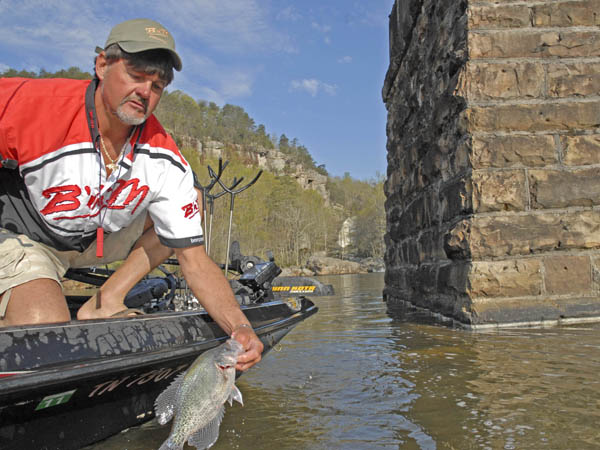
side the concrete piling. On each cast, the anglers count their jigs down and then begin to retrieve. They’ll first cast and retrieve right below the surface of the water, because often on a bright, warm February day – even in cold weather – you may pinpoint crappie only a foot or two under the surface. With each successive cast, the angler will allow the jig to drop from 6 inches to 1 foot deeper than the cast before, retrieving it to the boat with a steady retrieve. When a fish strikes, the angler will continue to fish that depth of water to try and take more slabs.
To take concrete crappie, you need to keep the jig bumping the concrete as long as possible during the retrieve. Many times a papermouth will take the bait just as it leaves the end of a concrete structure. As long as the jigs have contact with the concrete, an angler can catch more crappie than if the jigs swim in open water 2 or 3 inches from the concrete. Concrete crappie soon will wise-up to the color of the jigs you're throwing and quit biting. But by changing the color of your jigs when the crappie stop hitting one color of jig, often you can keep-on taking crappie. Of course, anglers may cast every color of jigs in their tackle boxes without the crappie taking the bait, until the fish find the exact color they want on that specific day. Once anglers discover the particular color the crappie will hit, they may limit-out on fat slabs in February.
When fishing live bait, some anglers have found that keeping the minnow in contact with the concrete and anchoring the boat out either a pole or a rod's length from the structure will pay off in more bites. Setting the cork or fishing a tight line at various depths will allow the angler to determine at what depth the crappie will feed. Once the angler starts getting bites, then he can change all the lines to place the baits at the depths where the crappie hold. In a current situation, let the cork bump the concrete to wash the bait down the side of the structure and into the eddy hole to trigger strikes.
 One of the best live-bait fishermen, Tom Adams, has a theory about live bait and catching crappie. "I believe on certain days crappie prefer one size of bait over another size. Although some days they want small minnows, on other days they like large minnows. I have found that crappie become accustomed to feeding on the size of bait that is the most prevalent on the structure where they're holding. If most of the baitfish holding on the concrete structure are small and the crappie are used to eating that small bait, then perhaps the crappie will be more likely to take a small minnow than a big minnow. If the baitfish in that structure are large, and the crappie feed on the big baits, then an angler naturally can assume that larger minnows will produce more crappie in that area than smaller minnows will. But there is no sure way of knowing until you start fishing. When I go out for a day of fishing, I carry a bucket of small minnows and a bucket of large minnows and experiment with both to see which size of bait the crappie prefer. If I catch more crappie on small minnows, then I only utilize small minnows until I use up all of the bait I have. When I run out of small minnows, I will try to fish the large minnows.
  However, if I find that the crappie are turning-down the larger bait, I leave the structure and return to the bait shop to buy more small minnows. I think that not giving the crappie the size of bait they prefer is a mistake many crappie fishermen make. My time is better spent by going back to the bait shop to purchase the size of minnows the fish are biting that day rather than to trying to convince the crappie holding on the concrete structure to bite a bait bigger than what they want. This principle applies to larger minnows as well as small minnows. If the crappie prove they favor the bigger minnows, I don't try to persuade the fish to take small minnows. After the fish tell me what bait they want to bite, I try to provide it."
All of us have fished bridge pilings one day and then not had a bite on that same concrete piece of structure on other days. However, when out crappie fishing in February, never pass by a large piece of concrete in February weather that you don't cast a jig to it or drop a minnow around it. The crappie will hunt warm water, and you may find hot February slab action at concrete structures. Too, fishing in February means there’s plenty of cold-weather crappie to be caught, the competition for the fish is almost non-existent, and the action often will be fast and furious.
Check out Pops Country Store! You might see something that you need.
 |
Entry 653, Day 5
|
 One of the best live-bait fishermen, Tom Adams, has a theory about live bait and catching crappie. "I believe on certain days crappie prefer one size of bait over another size. Although some days they want small minnows, on other days they like large minnows. I have found that crappie become accustomed to feeding on the size of bait that is the most prevalent on the structure where they're holding. If most of the baitfish holding on the concrete structure are small and the crappie are used to eating that small bait, then perhaps the crappie will be more likely to take a small minnow than a big minnow. If the baitfish in that structure are large, and the crappie feed on the big baits, then an angler naturally can assume that larger minnows will produce more crappie in that area than smaller minnows will. But there is no sure way of knowing until you start fishing. When I go out for a day of fishing, I carry a bucket of small minnows and a bucket of large minnows and experiment with both to see which size of bait the crappie prefer. If I catch more crappie on small minnows, then I only utilize small minnows until I use up all of the bait I have. When I run out of small minnows, I will try to fish the large minnows.
  However, if I find that the crappie are turning-down the larger bait, I leave the structure and return to the bait shop to buy more small minnows. I think that not giving the crappie the size of bait they prefer is a mistake many crappie fishermen make. My time is better spent by going back to the bait shop to purchase the size of minnows the fish are biting that day rather than to trying to convince the crappie holding on the concrete structure to bite a bait bigger than what they want. This principle applies to larger minnows as well as small minnows. If the crappie prove they favor the bigger minnows, I don't try to persuade the fish to take small minnows. After the fish tell me what bait they want to bite, I try to provide it."