
|
Features
|
|
|
|
Books
|
|
|
|
Fun & Games
|
|
|
|
Contact Us
|
|
|
John's Journal... Entry 73, Day 3
When to Use Different Types of Duck Calls
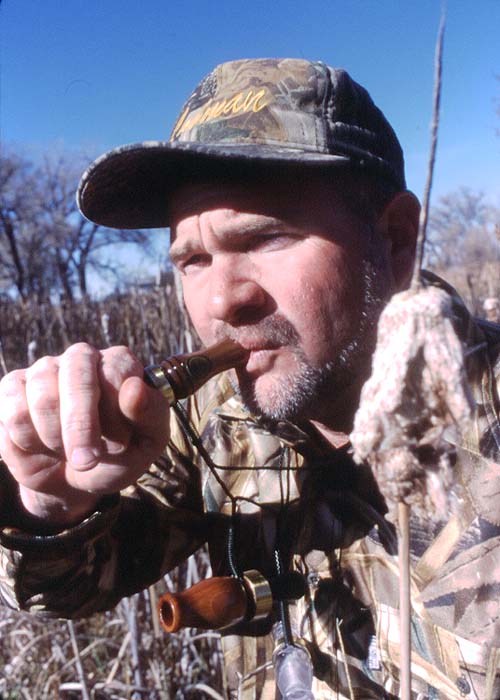 EDITOR'S
NOTE: Brad Harris, vice president of public relations at Outland Sports,
the owners of Lohman and M.A.D. calls, is a hunting expert and a longtime
duck hunter. More than 26-million households across the nation watch Outland
Sports television show, "Outdoor Traditions with Brad Harris."
EDITOR'S
NOTE: Brad Harris, vice president of public relations at Outland Sports,
the owners of Lohman and M.A.D. calls, is a hunting expert and a longtime
duck hunter. More than 26-million households across the nation watch Outland
Sports television show, "Outdoor Traditions with Brad Harris."
Question: Brad, when you look at a duck hunter,
he usually has three, four or even five duck calls hanging around his
neck. What calls do you always carry with you, when do you use which one,
and why do you have so many calls?
Answer: A lot of it depends on where I'm
hunting and the type of conditions I'm in. I use loud, ringing calls if
the conditions are very windy, the fields or water are big, I'm trying
to call from a long distance, or I've got a lot of flight ducks that are
traveling the area and I need to get their attention. I want to reach
out there during those windy days or in long-range situations. In those
situations, I always have a couple of calls like the Marsh Master single
reed because it's a good ringing hail call, is very ducky and gives you
the soft, close-in sounds. I can bring in ducks from a long way with this
call and calm them down when they're in tight. I always have two of the
Marsh Master calls around my neck. Generally I'll have a double reed so
I can switch if: I get a little lazy; I want to give the ducks a different
sound; I become tired of blowing a certain call; I want to take a break;
and/or I want to keep myself sharp.
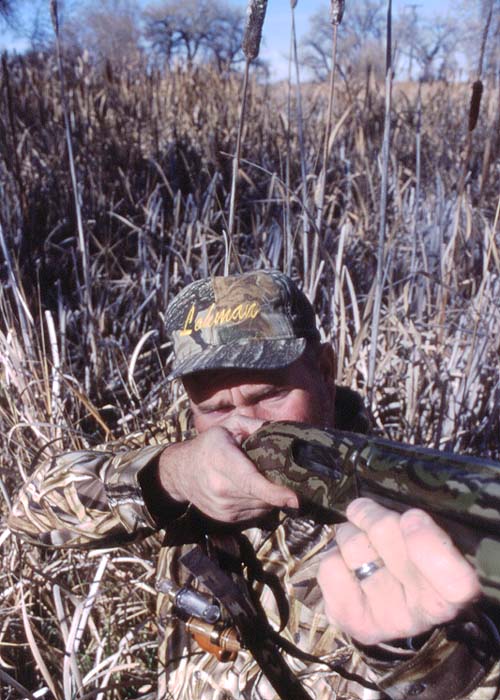 Always
have two or three different sounds with you because on some days ducks
respond to one sound over others. Having different calls gives you versatility.
Always
have two or three different sounds with you because on some days ducks
respond to one sound over others. Having different calls gives you versatility.
If I'm in marshy timber areas or pothole-type situations where I've got ducks in the immediate area and I'm working ducks in close, then I'll use a much softer call like the Duck Buster from Big River. It's a real soft, easy-blowing call. Since you want to blow those ducks out on those days, I'll have a couple of the Duck Busters around my neck as well as the Marsh Master long-range call -- just in case the wind comes up, and I need that extra volume. So the reasons you would have three or four calls will be to change the sound and to give you the versatility you need in different situations.
Tomorrow: Reading the Ducks
Check back each day this week for more about Brad Harris On Duck Hunting ...
Day 1 -General Duck-Hunting
Information
Day 2 -Acrylic vs. Wood Duck Calls
Day 3 -When to Use Different Types of Duck
Calls
Day 4 -Reading the Ducks
Day 5 -Hunting Ducks in High-Pressure Areas