
|
Features
|
|
|
|
Books
|
|
|
|
Fun & Games
|
|
|
|
Contact Us
|
|
|
John's Journal... Entry 84, Day 4
The Turkey Hunter's Dictionary -- R's - S's
 EDITOR'S
NOTE: I've compiled a turkey-hunter's dictionary for this week to
enable you to communicate your turkey-hunting experience to other sportsmen
and understand what they're telling you. Today, we'll look at turkey-hunting
words beginning with R's- S's. You'll want to print out the entire Turkey
Hunter's Dictionary to keep to refer to, and then you'll know what other
hunters mean when they talk about their turkey-hunting experiences.
EDITOR'S
NOTE: I've compiled a turkey-hunter's dictionary for this week to
enable you to communicate your turkey-hunting experience to other sportsmen
and understand what they're telling you. Today, we'll look at turkey-hunting
words beginning with R's- S's. You'll want to print out the entire Turkey
Hunter's Dictionary to keep to refer to, and then you'll know what other
hunters mean when they talk about their turkey-hunting experiences.
My day of turkey hunting starts the night before when I roost a gobbler. I not only want to know where the gobbler roosts, I want to pick a spot from which to call the following morning. If the tom doesn't gobble on his own, I'll try to get him to shock gobble. I have had a turkey move from limb to limb during the night, and then when I set up on him the next morning he'd be so close to the spot I'd chosen the night before that I could see his snood and spurs. I've watched as subdominant gobblers and hens walked in under the tree where the bird had roosted and now gobbled. When a turkey's that's close, I like to use a striker and box to give light, subtle calls. But I have had a bird like this fly off the limb, strut with his hens, go to feed and by 10:00 a.m. arrive at his strut zone.
 Roost:
A particular tree where a turkey perches during the night for sleeping.
Roost:
A particular tree where a turkey perches during the night for sleeping.
Scouting: Taking inventory of the area you plan to hunt. Looking for turkey sign, listening for turkey sounds and becoming aware of the terrain and habitat can help in determining a hunt plan.
Setup: An area where you determine a turkey should come, and where you'll take a stand to call and wait. A good setup will generally be in clean woods with no natural barriers that the turkey would have to cross to get to you.
Shock gobble: The instinctive reaction of a turkey in response to some type of loud sound. A tom may shock-gobble when he hears a car door slamming, a train whistle, a clap of thunder, a crow call, or any other loud, high-pitched noise.
Slate call: A caller consisting of a peg and a piece of slate. The peg is stroked across the slate to produce the sound of the turkey. The slate is sometimes enclosed in plastic, wood or any substance like a turtle shell. Snood or snoot: A bump on the forehead of a turkey that changes size according to how excited the turkey is.
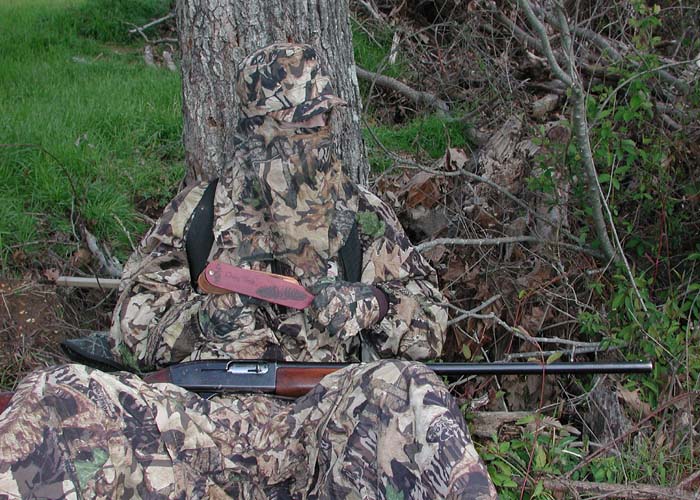
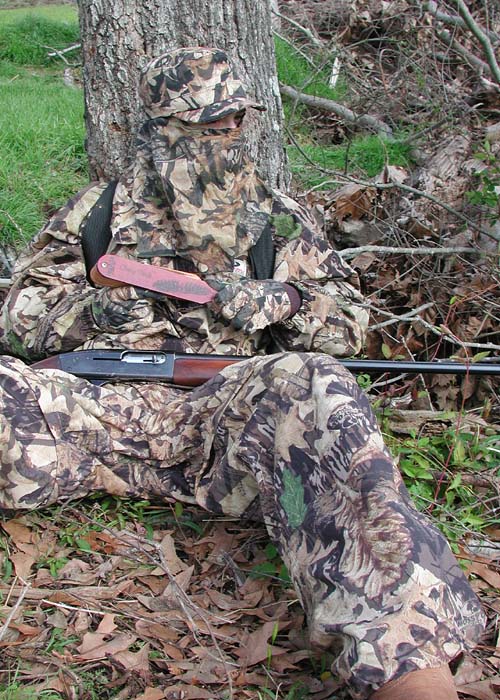 Snuff
box: A caller made from a snuff can. The bottom and half of the top are
cut away, and latex rubber is stretched over part of the open half of
the top. To operate the snuff box caller, the hunter rests his bottom
lip against the rubber and blows air across it. The sound made from the
air rushing across the rubber is amplified within the snuff can. The snuff
box was the forerunner of what is commonly known today as the tube caller.
Snuff
box: A caller made from a snuff can. The bottom and half of the top are
cut away, and latex rubber is stretched over part of the open half of
the top. To operate the snuff box caller, the hunter rests his bottom
lip against the rubber and blows air across it. The sound made from the
air rushing across the rubber is amplified within the snuff can. The snuff
box was the forerunner of what is commonly known today as the tube caller.
Spur: A horny growth on a male turkey's leg, which sometimes also occurs on a hen's leg. At two years of age, most gobblers have one one-inch spur on each leg. However, some gobblers have no spurs, and some have multiple spurs.
Striker box: Either a slate-covered wooden box used by rubbing a wooden peg across it to imitate the call of a wild turkey. This type of caller is also known as a friction call. Strutting: The action seen when a turkey coils his neck, causes his feathers to stand up, spreads his tail and drops his wings to impress a hen. A strutting turkey is much like a man on the beach who flexes all his muscles to draw attention to himself and impress any ladies who may see him.
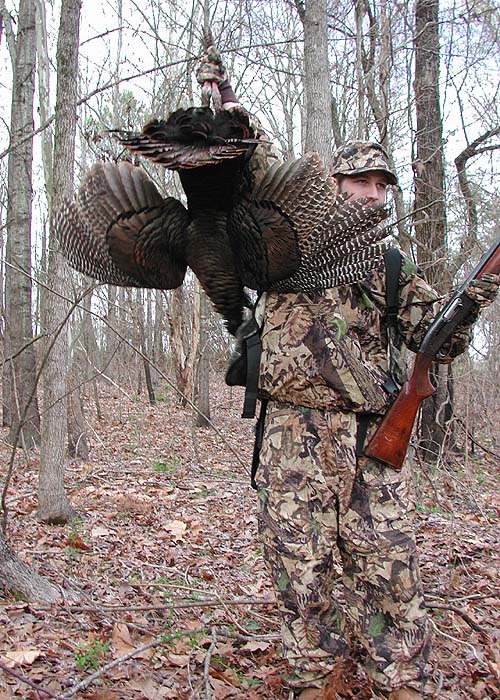 Strut
Zone: An area where a turkey goes on a regular basis to strut and meet
a hen for breeding. Subdominant gobblers and hens: Turkeys subservient
to the dominant birds in a flock. A subdominant turkey may become dominant
if the dominant turkey is removed from the flock.
Strut
Zone: An area where a turkey goes on a regular basis to strut and meet
a hen for breeding. Subdominant gobblers and hens: Turkeys subservient
to the dominant birds in a flock. A subdominant turkey may become dominant
if the dominant turkey is removed from the flock.
To learn more about turkey hunting, order John E. Phillips' three turkey-hunting books by going back to Night Hawk's Homepage and clicking on "Books"; or, call (800) 627-4295 to receive a free brochure.
TOMORROW: The Turkey Hunter's Dictionary -- T'S - Y's
Check back each day this week for more about Bo Pitman's Offbeat Tom Tactics ...
Day 1 -The Turkey Hunter's
Dictionary -- A's - C's
Day 2 -The Turkey Hunter's Dictionary --
D's - I's
Day 3 -The Turkey Hunter's Dictionary --
J's - P's
Day 4 -The Turkey Hunter's Dictionary --
R's - S's
Day 5 -The Turkey Hunter's Dictionary --
T'S - Y's