
|
Features
|
|
|
|
Books
|
|
|
|
Fun & Games
|
|
|
|
Contact Us
|
|
|
John's Journal... Entry 95, Day 2
Fishing For Tarpon
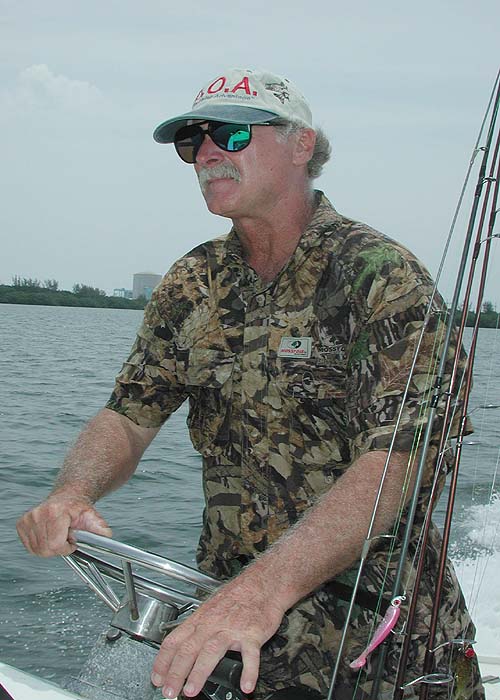 EDITOR'S
NOTE: Mark Nichols, the president of DOA (Deadly On Anything) lures,
knows the Palm City area of Florida about 40 minutes north of West Palm
Beach on the Atlantic Ocean like the back of his hand. He's learned how
to take speckled trout, redfish, tarpon and snook. His tactics also will
produce these species anywhere you fish with his lures. This week we'll
look at how, where and why Nichols, one of the first anglers to bring
Mossy Oak into the saltwater arena, uses the techniques he does to catch
these inshore species. Nichols enjoys wearing Mossy Oak Apparel's TrekLite
shirts, pants and shorts for saltwater fishing. As Nichols says, "I'm
not wearing TrekLite clothes to hide from the fish. These clothes are
just lightweight, comfortable and cool, they dry fast, and they define
me as an outdoorsman. What most hunters don't know is that TrekLite clothing
is also appropriate for hunting and saltwater fishing."
EDITOR'S
NOTE: Mark Nichols, the president of DOA (Deadly On Anything) lures,
knows the Palm City area of Florida about 40 minutes north of West Palm
Beach on the Atlantic Ocean like the back of his hand. He's learned how
to take speckled trout, redfish, tarpon and snook. His tactics also will
produce these species anywhere you fish with his lures. This week we'll
look at how, where and why Nichols, one of the first anglers to bring
Mossy Oak into the saltwater arena, uses the techniques he does to catch
these inshore species. Nichols enjoys wearing Mossy Oak Apparel's TrekLite
shirts, pants and shorts for saltwater fishing. As Nichols says, "I'm
not wearing TrekLite clothes to hide from the fish. These clothes are
just lightweight, comfortable and cool, they dry fast, and they define
me as an outdoorsman. What most hunters don't know is that TrekLite clothing
is also appropriate for hunting and saltwater fishing."
 Question:
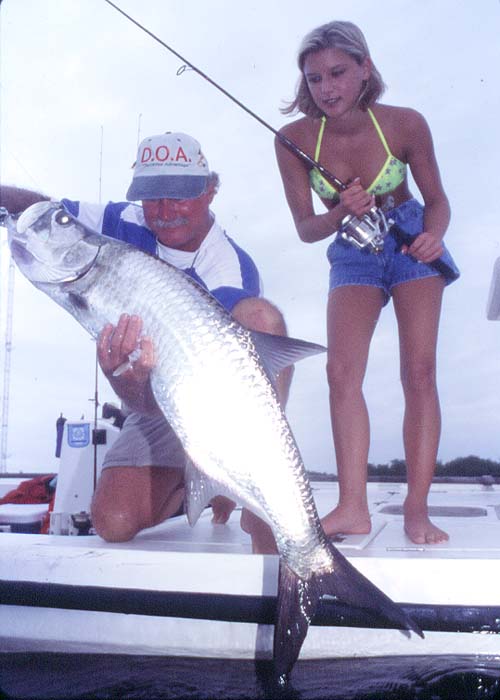
Mark, on the day we fished together, you jumped a 125-pound tarpon within
20 feet of the boat. You hooked that tarpon on a small, soft-plastic lure
that looked like a baitfish. What was that lure?
Question:
Mark, on the day we fished together, you jumped a 125-pound tarpon within
20 feet of the boat. You hooked that tarpon on a small, soft-plastic lure
that looked like a baitfish. What was that lure?
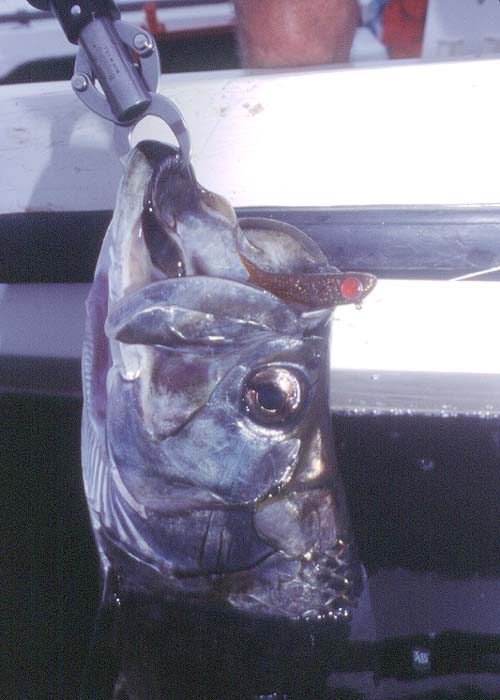
Answer: The bait is called a Terror-Eyz, which is a nondescript
soft-plastic lure with red eyes. The bait is so deadly because it is nondescript.
When a tarpon sees it falling, he can't really tell if it's a crab, a
shrimp or some type of little fish. When you cast small nondescript lures
in clear water in the middle of the day, you don't want the fish to see
exactly with what you're fishing. If they get a good look at the bait,
they may not attack. But if some type of bait passes by them quickly,
their natural instincts will cause them to attack.
Question: How are you casting to the tarpon with
this small bait?
Answer: When I see the fish roll, I try and cast right in front
of the rolling tarpon. I want the lure to fall right in front of the fish's
face. When tarpon are holding in an area and not moving in and out of
a pass, they will usually come up for a gulp of air and go straight back
toward the bottom. When they spot a small bait dropping in front of their
faces, they'll often inhale that little bait, and that's when I hook them.
When you're fishing for rolling tarpon, you don't really want to swim
the bait. You want to fish it on the drop.
 Question:
Mark, you're fishing for these tarpon using medium-action spinning tackle.
These tarpon will weigh 40 to 175 pounds. What type of line are you using,
and why are you using this light tackle?
Question:
Mark, you're fishing for these tarpon using medium-action spinning tackle.
These tarpon will weigh 40 to 175 pounds. What type of line are you using,
and why are you using this light tackle?
Answer: If I'm targeting big tarpon, I'll be fishing a relatively
stiff rod with a Shimano 4000 spinning reel with 30-pound-test Power Pro-braided
line. I use this line and this rod and reel combo because I can make long
casts anytime I see a school of tarpon roll. South Florida fishermen will
usually be fishing spinning tackle 90% of the time -- regardless of the
species of fish they're targeting. When I'm fishing for tarpon, I may
see them roll upwind, downwind or crosswind. Spinning tackle allows me
to cast to them no matter the wind condition. The spinning tackle also
prevents backlash, which often occurs if you're not casting with the wind.
Question: How big is the biggest tarpon you've
ever caught on the Terror-Eyz?
Answer: I've caught a 110-pound tarpon using the Terror-Eyz, which
has a wire hook in it.
 Question:
When you've got a tarpon that weighs 80 pounds or more on that light spinning
tackle, how do you get a fish to the boat?
Question:
When you've got a tarpon that weighs 80 pounds or more on that light spinning
tackle, how do you get a fish to the boat?
Answer: First of all, don't try and reel against the drag. When
the fish is taking drag off the reel, just keep steady pressure on the
rod, and don't try to reel in the fish. Don't attempt to reel the fish
in when it's stopped dead in the water. Be patient with the fish. Then
when the tarpon stops to turn your way, start to take up the line. I took
30 minutes to land an 80-pound tarpon last year using this system. Patience
will land more tarpon than power will.
For more information on DOA lures, call (877) DOA-LURE (362-5873), or visit the website at www.doalures.com. To learn more about Mossy Oak Apparel's TrekLite clothing for hunting and fishing, go to www.mossyoak.com.
TOMORROW: Catching Redfish
Check back each day this week for more about How To Catch Fish Inshore ...
Day 1 -Catching Speckled
Trout and Wearing TrekLite
Day 2 -Fishing For Tarpon
Day 3 -Catching Redfish
Day 4 -How To Fish for Snook
Day 5 -How to Take Trophy speckled Trout
Anywhere