
|
Features
|
|
|
|
Books
|
|
|
|
Fun & Games
|
|
|
|
Contact Us
|
|
|
John's Journal... Entry 136, Day 5
TURKEY CHALLENGE
Taking A Hermit Gobbler
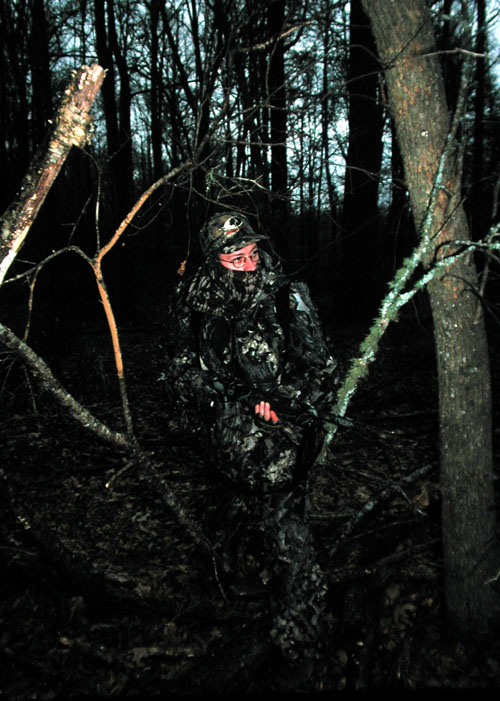 EDITOR'S
NOTE: There have been times in my hunting career when I've had to
fight my natural urge to take a turkey so that I could learn important
lessons about turkey hunting. But, on no hunt was my patience tested more
than when I hunted with Allen Jenkins, president of Lynch Calls. Jenkins
learned to hunt turkeys from an old master during the days when few people
even knew what a wild turkey looked like, much less how to call and hunt
one.
EDITOR'S
NOTE: There have been times in my hunting career when I've had to
fight my natural urge to take a turkey so that I could learn important
lessons about turkey hunting. But, on no hunt was my patience tested more
than when I hunted with Allen Jenkins, president of Lynch Calls. Jenkins
learned to hunt turkeys from an old master during the days when few people
even knew what a wild turkey looked like, much less how to call and hunt
one.
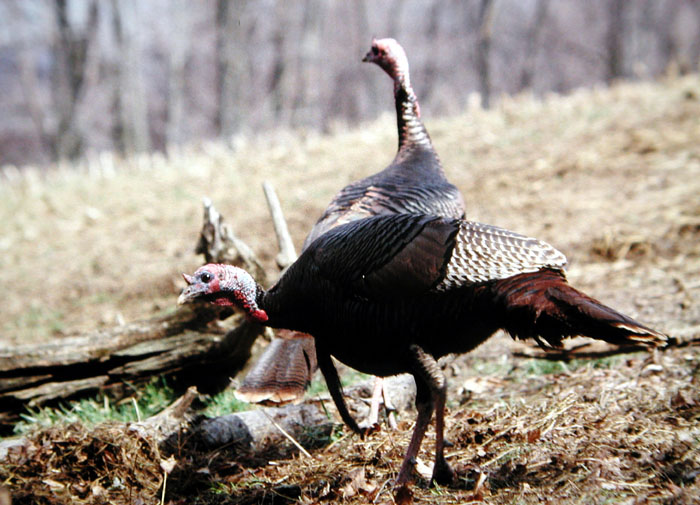
Hermit turkeys are rare birds that few sportsmen have the opportunity to hunt. As a master turkey hunter, Jenkins seeks out the hermit birds and hunts them every chance he gets. According to Jenkins, "To be classified as a hermit, a gobbler must be at least five-years old and should travel by himself. As the turkey gets older, he will rarely be with hens. A hermit tom usually will gobble very little if at all. And in most turkey hunting circles, these birds are classified as silent gobblers. "Also a hermit turkey should have an unusual track so the hunter can keep up with the tom and learn his movement patterns. Some of the hermits I've hunted have had clubfeet, crooked toes or bent toes.
 "I
never will kill a hermit, although I may have many chances. Hermits are
the smartest turkeys in the world. If you find one and kill him, you may
never get to hunt a bird like that again. Locating a hermit tom is the
true test of a master turkey hunter. If you beat a hermit turkey, then
you can truly be classified as a champion turkey taker." When Jenkins
speaks of "beating the turkey," he does not mean killing the turkey. Instead,
he refers to getting the turkey to within killing range and then allowing
the bird to walk off. "Each time you work a hermit gobbler, he gets smarter
and smarter," Jenkins mentioned. "The longer you fool with him, the more
challenging the game becomes."
"I
never will kill a hermit, although I may have many chances. Hermits are
the smartest turkeys in the world. If you find one and kill him, you may
never get to hunt a bird like that again. Locating a hermit tom is the
true test of a master turkey hunter. If you beat a hermit turkey, then
you can truly be classified as a champion turkey taker." When Jenkins
speaks of "beating the turkey," he does not mean killing the turkey. Instead,
he refers to getting the turkey to within killing range and then allowing
the bird to walk off. "Each time you work a hermit gobbler, he gets smarter
and smarter," Jenkins mentioned. "The longer you fool with him, the more
challenging the game becomes."
 Jenkins
told me about the School Bus Hermit that would only gobble at 7:36 A.M.
when a school bus went down a dirt road, hit a certain bump and jarred
the windows on the bus. "That clubfoot tom would only gobble one time
each day," Jenkins reported. And as Jenkins spoke of the School Bus Hermit,
you could tell he was talking about an old friend he had met on the field
of combat many a spring morning. Although the duel between Jenkins and
the School Bus Hermit could have been to the death, each combatant played
the game nobly. And when the contest for the day was over, each knew more
about the other's strengths and weaknesses.
Jenkins
told me about the School Bus Hermit that would only gobble at 7:36 A.M.
when a school bus went down a dirt road, hit a certain bump and jarred
the windows on the bus. "That clubfoot tom would only gobble one time
each day," Jenkins reported. And as Jenkins spoke of the School Bus Hermit,
you could tell he was talking about an old friend he had met on the field
of combat many a spring morning. Although the duel between Jenkins and
the School Bus Hermit could have been to the death, each combatant played
the game nobly. And when the contest for the day was over, each knew more
about the other's strengths and weaknesses.
 "If
J.C. comes in at 9:00 A.M. to work on a morning during turkey season and
says that he beat an old gobbler that day, he doesn't have to have a dead
turkey in hand to prove that he won the game," Jenkins explained. "If
J.C. says he beat the turkey, then I and J.C. know that he could have
taken the bird if he wanted to, but he left the gobbler so that he could
hunt the tom again another day."
"If
J.C. comes in at 9:00 A.M. to work on a morning during turkey season and
says that he beat an old gobbler that day, he doesn't have to have a dead
turkey in hand to prove that he won the game," Jenkins explained. "If
J.C. says he beat the turkey, then I and J.C. know that he could have
taken the bird if he wanted to, but he left the gobbler so that he could
hunt the tom again another day."
Playing the game fairly -- hunting the old way -- does not require taking a limit of turkeys each season. Playing the game fairly does not require the hunter to win every time. Instead, it allows for more enjoyment of the sport of turkey calling and builds memories that last. Playing the game fairly and hunting the old way still works today for taking turkeys just like it has for many years.
Check back each day this week for more about Turkey Challenges ...
Day 1 - Don't Move on a
Hung-up Gobbler
Day 2 - Why Not Kill The Bird?
Day 3 - Calling In The Hung-Up Turkey
Day 4 - Play Fairly
Day 5 - Taking A Hermit Gobbler