
|
Features
|
|
|
|
Books
|
|
|
|
Fun & Games
|
|
|
|
Contact Us
|
|
|
John's Journal... Entry 189, Day 1
REASONS WHY I MISS TURKEYS
The Almost-Perfect Shot
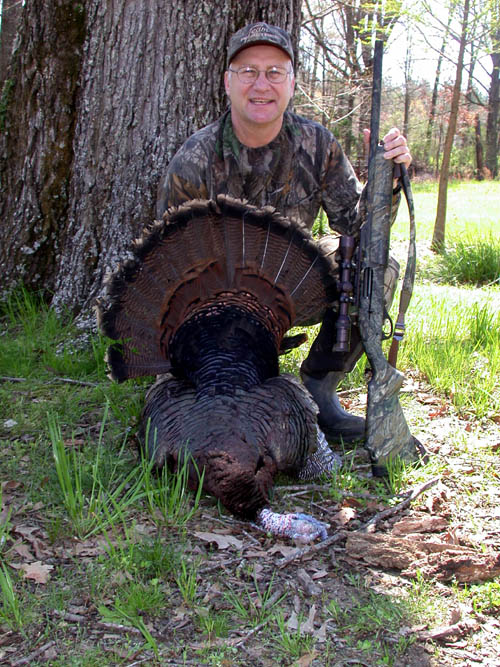 EDITOR'S
NOTE: An outdoor writer friend of mine came in
from turkey hunting with his head down, looking dejected. Instantly I
knew what had happened. "You missed him, didn't you?" I asked my friend,
whose name must remain anonymous to protect the guilty. "Yeah, I missed
him," he replied. "You're not going to believe this, but that's the first
gobbler I ever missed." From his response, I knew that my friend hadn't
hunted turkeys very much. I looked at him and smiled. "If you can make
that statement in all honesty, then I know that you haven't taken more
than six turkeys in your lifetime." My friend smiled a sheepish grin and
said, "Yeah, I've bagged about six birds." The one thing I know for certain
is that the only people who don't miss turkeys are the people who don't
hunt them. Regardless of how well you shoot, how close you let the turkeys
get, what type of gun and ammunition you use, and how many years you've
hunted, you're still going to miss turkeys. Turkeys have an uncanny ability
to dodge shots. I don't know how they do it; they just do. This week we'll
look at reasons why I've missed turkeys. Most hunters probably won't tell
on themselves. However, I know that the turkey hunters who read this article
will appreciate my honesty and perhaps learn from my mistakes.
EDITOR'S
NOTE: An outdoor writer friend of mine came in
from turkey hunting with his head down, looking dejected. Instantly I
knew what had happened. "You missed him, didn't you?" I asked my friend,
whose name must remain anonymous to protect the guilty. "Yeah, I missed
him," he replied. "You're not going to believe this, but that's the first
gobbler I ever missed." From his response, I knew that my friend hadn't
hunted turkeys very much. I looked at him and smiled. "If you can make
that statement in all honesty, then I know that you haven't taken more
than six turkeys in your lifetime." My friend smiled a sheepish grin and
said, "Yeah, I've bagged about six birds." The one thing I know for certain
is that the only people who don't miss turkeys are the people who don't
hunt them. Regardless of how well you shoot, how close you let the turkeys
get, what type of gun and ammunition you use, and how many years you've
hunted, you're still going to miss turkeys. Turkeys have an uncanny ability
to dodge shots. I don't know how they do it; they just do. This week we'll
look at reasons why I've missed turkeys. Most hunters probably won't tell
on themselves. However, I know that the turkey hunters who read this article
will appreciate my honesty and perhaps learn from my mistakes.
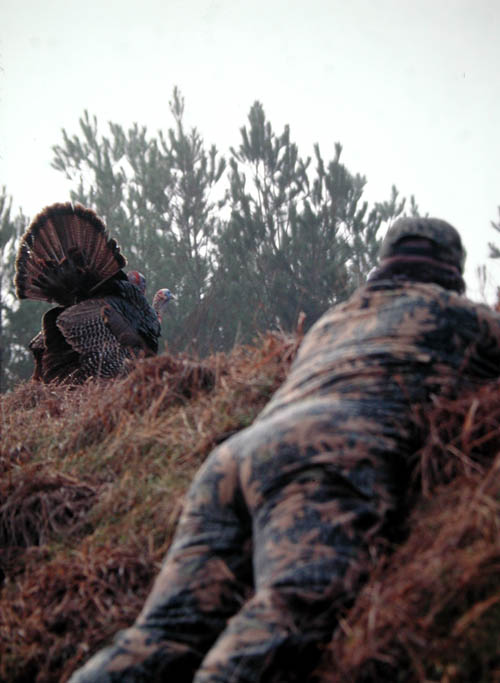 Scott
Dillon, a guide at White Oak Plantation in Tuskegee, Alabama, and I had
hunted the same flock of turkeys for two days. We knew that four big gobblers
were living on the property line. Sometimes these birds were on White
Oak's property; then at times they were on the neighbor's property. One
morning the neighbor was hunting the same four gobblers we were. The birds
had been talking for about two hours, and we'd set up and attempted to
call them about five times. The neighbor also was calling to the turkeys.
As he moved closer to the property line, so did the gobblers. "I think
the neighbor's going to drive those gobblers right to us," Dillon commented.
"Let's move up to one of these little valleys and wait for them." I sat
down by a tree facing the valley and got ready. Dillon sat behind me where
he could see both sides of the valley. He made three light clucks, then
whispered, "Look to your left, John. All four longbeards are coming up
the valley." Since I'm a left-handed shooter, I had a very limited field
of view to my left. "I can't see the turkeys," I told Dillon. He responded,
"They're coming straight at us, John. Look hard left." "I still can't
see them," I told Dillon. "I've got to turn all the way around if I'm
going to get a shot." A full minute passed, and Dillon finally said, "Okay,
turn around on the tree, and you'll see the gobblers." I turned to my
left and saw a red head at about 30 yards. Bringing my Remington 870 to
my shoulder, I looked through my Kahles scope and positioned the turkey's
head in the center of the reticles. However, just as I squeezed the trigger,
I noticed a baseball-bat-sized tree covering the turkey's head. "You missed
him," Dillon said as he began to cluck loudly on his Woods Wise slate
call. "Look hard right. I saw a second gobbler's head." This time when
I centered the turkey's head in the diamond shape of my scope and squeezed
the trigger, that bird went down.
Scott
Dillon, a guide at White Oak Plantation in Tuskegee, Alabama, and I had
hunted the same flock of turkeys for two days. We knew that four big gobblers
were living on the property line. Sometimes these birds were on White
Oak's property; then at times they were on the neighbor's property. One
morning the neighbor was hunting the same four gobblers we were. The birds
had been talking for about two hours, and we'd set up and attempted to
call them about five times. The neighbor also was calling to the turkeys.
As he moved closer to the property line, so did the gobblers. "I think
the neighbor's going to drive those gobblers right to us," Dillon commented.
"Let's move up to one of these little valleys and wait for them." I sat
down by a tree facing the valley and got ready. Dillon sat behind me where
he could see both sides of the valley. He made three light clucks, then
whispered, "Look to your left, John. All four longbeards are coming up
the valley." Since I'm a left-handed shooter, I had a very limited field
of view to my left. "I can't see the turkeys," I told Dillon. He responded,
"They're coming straight at us, John. Look hard left." "I still can't
see them," I told Dillon. "I've got to turn all the way around if I'm
going to get a shot." A full minute passed, and Dillon finally said, "Okay,
turn around on the tree, and you'll see the gobblers." I turned to my
left and saw a red head at about 30 yards. Bringing my Remington 870 to
my shoulder, I looked through my Kahles scope and positioned the turkey's
head in the center of the reticles. However, just as I squeezed the trigger,
I noticed a baseball-bat-sized tree covering the turkey's head. "You missed
him," Dillon said as he began to cluck loudly on his Woods Wise slate
call. "Look hard right. I saw a second gobbler's head." This time when
I centered the turkey's head in the diamond shape of my scope and squeezed
the trigger, that bird went down.
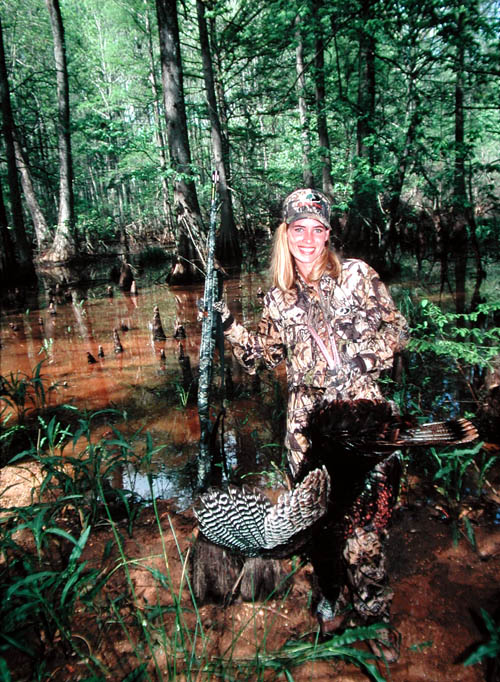 After
Dillon and I collected the downed gobbler, we went to look for the first
gobbler. "The bad news is you missed him," Dillon explained. "The good
news is you missed him cleanly. You only cut one feather, and there's
no sign that the bird was injured." "Well, I actually saw the first gobbler
run off," I tried to explain. "That's the reason I swung on the second
bird. I knew I didn't touch the first bird." The truth was that I was
so intent on taking a gobbler, my eyes played tricks on me. I didn't notice
the tree limb between me and the bird until after I pulled the trigger.
After
Dillon and I collected the downed gobbler, we went to look for the first
gobbler. "The bad news is you missed him," Dillon explained. "The good
news is you missed him cleanly. You only cut one feather, and there's
no sign that the bird was injured." "Well, I actually saw the first gobbler
run off," I tried to explain. "That's the reason I swung on the second
bird. I knew I didn't touch the first bird." The truth was that I was
so intent on taking a gobbler, my eyes played tricks on me. I didn't notice
the tree limb between me and the bird until after I pulled the trigger.
The Black-Powder Gobbler:
Another time, I had my CVA black-powder shotgun when I hunted with Bo Pitman, White Oak's lodge manager. I rested my gun on my knee, hammer back, ready to make a shot. The first turkey to pass through a small opening in the foliage was a jake. The second turkey to step into the opening was a longbeard. But I opted not to take him because the last bird in the parade was a big strutting gobbler. Bo Pitman said, "You'd better take the shot. That bird is getting nervous." Aiming carefully and accurately at the only tom I could see, I squeezed the trigger. A cloud of black smoke obstructed my view, but I stood up quickly after the shot and saw my turkey flopping. Laying my gun down, I began to race toward the bird. I thought to myself, "Boy, that black-powder shotgun sure must have blown that turkey back a long way because he's much farther out than he was when I shot him." When I reached the downed gobbler, I noticed that he had only a 3 ½-inch beard. "I can't believe I shot that turkey's beard off," I murmured to myself. "Wait. This gobbler looks like a jake, not the longbeard I tried to shoot." I couldn't believe my eyes. When Pitman saw the gobbler he said, "John, if I hadn't seen it, I never would have believed it. Did you see what happened?" "Yeah," I said. "The longbeard stepped into the hole, and I shot him." Pitman began to laugh. "That's not exactly how it happened. Just as you squeezed the trigger, the longbeard dropped down and ran. This goofy jake was standing behind the hill about 50 yards from where we were sitting. Apparently a stray pellet found its way to his neck and head area. You missed the bird you were aiming for, but you still took a turkey today."
To learn more about John E. Phillips' turkey-hunting books that contain information and tips from the nation's top turkey hunters, click here.
TOMORROW: THE CANTING GOBBLER
Check back each day this week for more about REASONS WHY I MISS TURKEYS ...
Day 1 - The Almost-Perfect
Shot
Day 2 - The Canting Gobbler
Day 3 - Missing Two Gobblers in One Day
Day 4 - The Hale Fail Gobbler
Day 5 - Miss Of The Man-Eater