
|
Features
|
|
|
|
Books
|
|
|
|
Fun & Games
|
|
|
|
Contact Us
|
|
|
John's Journal... Entry 228, Day 5
HOW TO HUNT CLEAR CUTS
Get High During the Rut in a Young Pine Plantation
 Editor's
Note: For most of their lives, Larry Norton of Pennington, Alabama, and
his cousin Ray Moseley either have been members of hunting clubs or operated
hunting clubs. In 2002, they decided to lease some property and allow
individuals to hunt on the property known as the Shed Hunting Lodge near
Butler in west/central Alabama. All this property lies on either private
or timber company lands, with the majority of the land clear cut. Most
deer hunters have difficulties hunting clear cuts and uneven-age-stand
plantations because they don't know the secrets for hunting these areas.
But the six hunters who hunted at the Shed last year all took deer, with
four of them harvesting bucks that scored 130 points or better on the
Boone & Crockett scale. This week, Larry Norton, who avidly hunts deer
for more than three months each year and also is a World Champion turkey
caller, will tell you secrets for hunting clear cuts and uneven-age pine
stands.
Editor's
Note: For most of their lives, Larry Norton of Pennington, Alabama, and
his cousin Ray Moseley either have been members of hunting clubs or operated
hunting clubs. In 2002, they decided to lease some property and allow
individuals to hunt on the property known as the Shed Hunting Lodge near
Butler in west/central Alabama. All this property lies on either private
or timber company lands, with the majority of the land clear cut. Most
deer hunters have difficulties hunting clear cuts and uneven-age-stand
plantations because they don't know the secrets for hunting these areas.
But the six hunters who hunted at the Shed last year all took deer, with
four of them harvesting bucks that scored 130 points or better on the
Boone & Crockett scale. This week, Larry Norton, who avidly hunts deer
for more than three months each year and also is a World Champion turkey
caller, will tell you secrets for hunting clear cuts and uneven-age pine
stands.
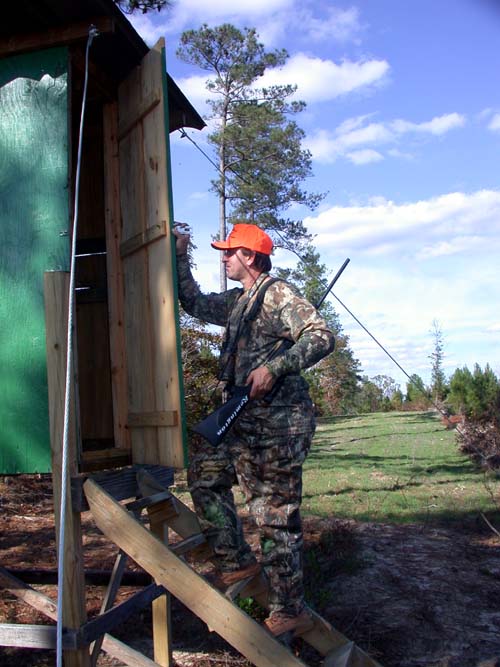 *
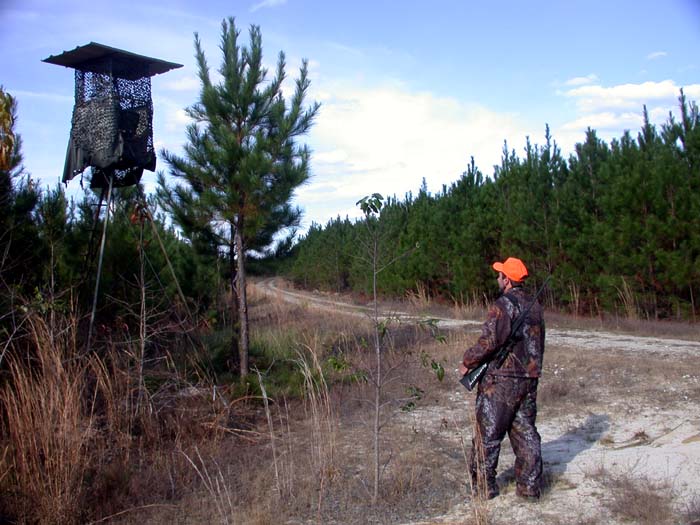
Put your tree stand as high as you feel comfortable on the edge of a clear
cut, if you're hunting a young pine plantation during the rut. Bucks like
to chase does out into clear cuts because their chances of running them
down and catching up to them is much better in clear cuts than it is in
a mature forest. Most of us when we see a buck chasing a doe 500-600 yards
from us start watching the buck and looking for a place to get a shot
at him instead of watching the doe. For many years, I made this same mistake.
But I've learned that if the doe is 5 or 10 minutes out in front of the
buck, I need to watch that doe to learn where she's going. If I spot a
doe going across the end of a ridge, a hollow, a fire break or a road
relatively close to me, I'll quickly and carefully climb out of my tree
stand and move to the place where the doe has crossed and get ready, because
that buck is going to stay right on that doe' trail. So wherever she's
gone, he's going to go. Using this technique, I've been able to take several
nice bucks that I couldn't have been able to take if I'd continued to
watch the buck and not the doe.
*
Put your tree stand as high as you feel comfortable on the edge of a clear
cut, if you're hunting a young pine plantation during the rut. Bucks like
to chase does out into clear cuts because their chances of running them
down and catching up to them is much better in clear cuts than it is in
a mature forest. Most of us when we see a buck chasing a doe 500-600 yards
from us start watching the buck and looking for a place to get a shot
at him instead of watching the doe. For many years, I made this same mistake.
But I've learned that if the doe is 5 or 10 minutes out in front of the
buck, I need to watch that doe to learn where she's going. If I spot a
doe going across the end of a ridge, a hollow, a fire break or a road
relatively close to me, I'll quickly and carefully climb out of my tree
stand and move to the place where the doe has crossed and get ready, because
that buck is going to stay right on that doe' trail. So wherever she's
gone, he's going to go. Using this technique, I've been able to take several
nice bucks that I couldn't have been able to take if I'd continued to
watch the buck and not the doe.
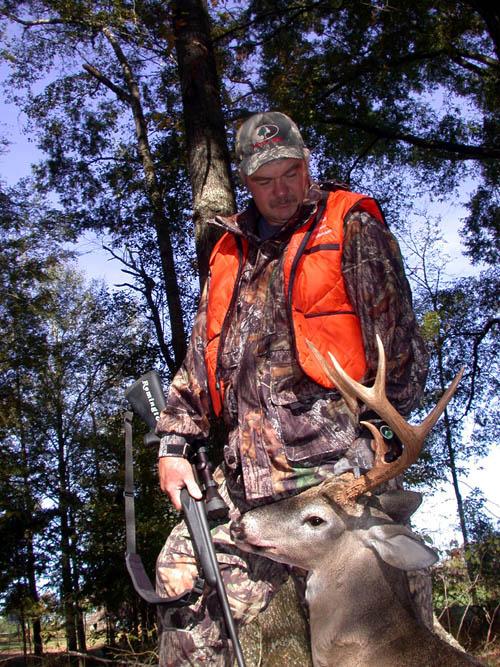 *
Use grunting and rattling during the rut in a young pine plantation. This
technique can be extremely deadly then. However, I've found that rattling,
even during the rut, isn't very effective in the part of Alabama where
I hunt, because we have more does than we have bucks. But grunting can
be deadly effective. I use the same technique -- cutting and running --
for grunting in bucks in clear cuts that I use when I'm calling turkeys.
When I'm calling turkeys, I'll cut and cackle and try to sound like an
excited hen. I'll usually wait 5 or 10 minutes, and if I don't hear a
turkey gobble back, I'll move on to another location. I use the same tactic
when hunting a buck in a clear cut. I want the wind in my face. I'll climb
up a tree and get in a tree stand, or I'll sit in a ground blind and start
grunting. Unlike most people using the grunt call to try to call in bucks,
I don't grunt three times and then remain silent for 10 minutes. I'll
grunt for a full minute or two without stopping. I point the barrel of
my grunt call in several different directions and move it around so that
I sound like a buck that's grunting and chasing a doe all around my tree
stand. If I don't see a deer within 10 minutes, I'll go about 50 yards
and repeat the same action. This way, I sound just like a buck that's
chasing a doe and then loses her and finally catches back up to her at
about 50 yards. I've been able to grunt in quite a few bucks by using
this technique. If you've ever heard a buck grunting when he's chasing
a doe, he doesn't grunt three times and stop. He's continuously grunting
while he chases her. Many times you won't see the buck instantly when
you start grunting. That's the reason I'll stay on my stand about 10 minutes
before I start grunting again when I'm hunting in a pine plantation. We've
proved that you can bag deer in a young pine plantation.
*
Use grunting and rattling during the rut in a young pine plantation. This
technique can be extremely deadly then. However, I've found that rattling,
even during the rut, isn't very effective in the part of Alabama where
I hunt, because we have more does than we have bucks. But grunting can
be deadly effective. I use the same technique -- cutting and running --
for grunting in bucks in clear cuts that I use when I'm calling turkeys.
When I'm calling turkeys, I'll cut and cackle and try to sound like an
excited hen. I'll usually wait 5 or 10 minutes, and if I don't hear a
turkey gobble back, I'll move on to another location. I use the same tactic
when hunting a buck in a clear cut. I want the wind in my face. I'll climb
up a tree and get in a tree stand, or I'll sit in a ground blind and start
grunting. Unlike most people using the grunt call to try to call in bucks,
I don't grunt three times and then remain silent for 10 minutes. I'll
grunt for a full minute or two without stopping. I point the barrel of
my grunt call in several different directions and move it around so that
I sound like a buck that's grunting and chasing a doe all around my tree
stand. If I don't see a deer within 10 minutes, I'll go about 50 yards
and repeat the same action. This way, I sound just like a buck that's
chasing a doe and then loses her and finally catches back up to her at
about 50 yards. I've been able to grunt in quite a few bucks by using
this technique. If you've ever heard a buck grunting when he's chasing
a doe, he doesn't grunt three times and stop. He's continuously grunting
while he chases her. Many times you won't see the buck instantly when
you start grunting. That's the reason I'll stay on my stand about 10 minutes
before I start grunting again when I'm hunting in a pine plantation. We've
proved that you can bag deer in a young pine plantation.
Check back each day this week for more about HOW TO HUNT CLEAR CUTS ...
Day 1 - Why Hunt Clear Cuts
Day 2 - How Norton Hunts a Young Pine Plantation
Day 3 - Hunt the Trash
Day 4 - Drive Them Out
Day 5 - Get High During the Rut in a Young
Pine Plantation