
|
Features
|
|
|
|
Books
|
|
|
|
Fun & Games
|
|
|
|
Contact Us
|
|
|
John's Journal... Entry 234, Day 5
SMOKING EASTERN COYOTES
How To Hunt Coyotes
 Editor's
Note: If you want to experience fun, off-season hunting this spring and
summer, try hunting coyotes, abundant in most areas of the East. Very
few other hunters hunt coyotes, landowners will look forward to your hunting,
and they'll do all they can to aid your success.
Editor's
Note: If you want to experience fun, off-season hunting this spring and
summer, try hunting coyotes, abundant in most areas of the East. Very
few other hunters hunt coyotes, landowners will look forward to your hunting,
and they'll do all they can to aid your success.
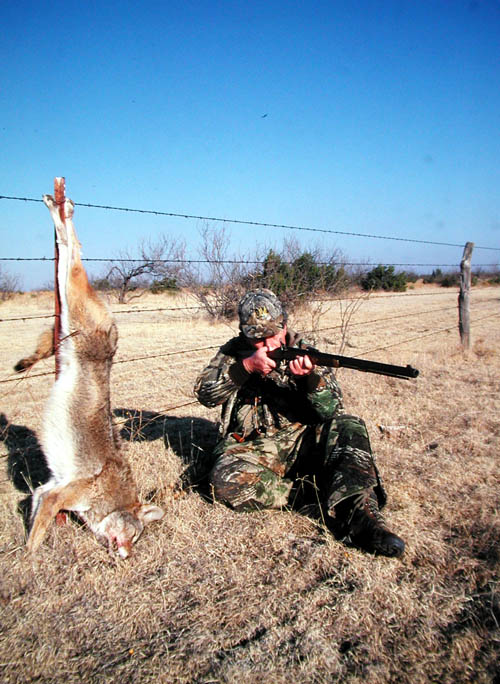
Often two sportsmen can team up to hunt coyotes for the most efficiency. Many times a coyote won't come straight to the caller. Because of a coyote's keen ears, it can pinpoint the location of the sound it's hearing. If the coyote doesn't see the animal making the call, the coyote may circle downwind to attempt to sneak up on what he thinks is another coyote. If the second hunter sits 30 yards behind the caller and watches the opposite direction from the direction where the caller looks, then the team will find success. Don't expect the coyote to come in prancing like a high-stepping walking horse. Often a coyote will respond to a call by crouching low or crawling on its belly.
 If
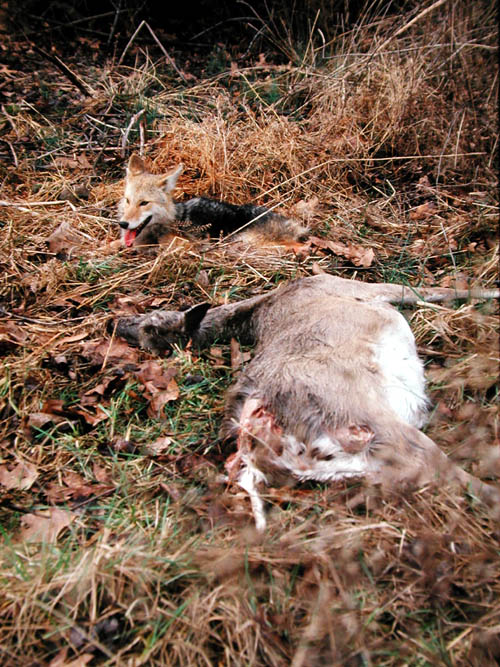
a hunter tries to take a coyote single-handedly, then the wind becomes
an important factor. The coyote has one the keenest noses in the predator
family and may pick up human odor if the hunter moves downwind. Brad Harris,
of Neosho, Missouri, with Fieldline, an avid coyote hunter, explains the
tactics he uses to take the brush dog. "Hunting into the wind is the most
critical key to successful coyote hunting," Harris told me. "These animals
have extremely keen noses. If they smell the hunter, they won't come in
to a call." Harris likes to take a stand with the wind in his face where
he can see for 150 yards. If you're hunting with black powder, you must
set up to call the coyotes within the range that you accurately can shoot
your black-powder rifle. Setting up close to thick cover where you can
see no more than 100 yards to the left or the right will prove an advantage
for the black-powder varmint hunter. If you set up where you can see 200
to 300 yards, although you may spot the coyote, you still won't get a
shot. Remember too, if you can watch the coyote at 200 to 300 yards, the
coyote also can see you. "When I call in the East or in relatively thick
cover, I call coyotes like I do turkeys," Harris explained. "I start off
with soft calling, maybe with the mouse squeaker or very soft, rabbit
squeals to possible lure in the close-by coyotes. If the coyotes don't
come in quickly, then I increase the volume of my calling to be able to
reach more territory and possibly pull in the coyotes from further away.
Most coyotes will come straight in to the call and then circle downwind
to pick up the scent of the animal the call indicates is in distress.
You must be able to see the coyotes either when they come in or as they
begin to circle downwind of you.
If
a hunter tries to take a coyote single-handedly, then the wind becomes
an important factor. The coyote has one the keenest noses in the predator
family and may pick up human odor if the hunter moves downwind. Brad Harris,
of Neosho, Missouri, with Fieldline, an avid coyote hunter, explains the
tactics he uses to take the brush dog. "Hunting into the wind is the most
critical key to successful coyote hunting," Harris told me. "These animals
have extremely keen noses. If they smell the hunter, they won't come in
to a call." Harris likes to take a stand with the wind in his face where
he can see for 150 yards. If you're hunting with black powder, you must
set up to call the coyotes within the range that you accurately can shoot
your black-powder rifle. Setting up close to thick cover where you can
see no more than 100 yards to the left or the right will prove an advantage
for the black-powder varmint hunter. If you set up where you can see 200
to 300 yards, although you may spot the coyote, you still won't get a
shot. Remember too, if you can watch the coyote at 200 to 300 yards, the
coyote also can see you. "When I call in the East or in relatively thick
cover, I call coyotes like I do turkeys," Harris explained. "I start off
with soft calling, maybe with the mouse squeaker or very soft, rabbit
squeals to possible lure in the close-by coyotes. If the coyotes don't
come in quickly, then I increase the volume of my calling to be able to
reach more territory and possibly pull in the coyotes from further away.
Most coyotes will come straight in to the call and then circle downwind
to pick up the scent of the animal the call indicates is in distress.
You must be able to see the coyotes either when they come in or as they
begin to circle downwind of you.
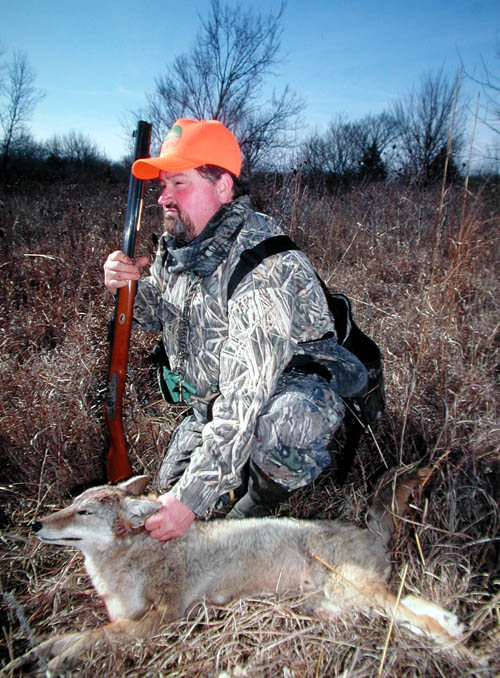 "I
like to hunt coyotes on backwoods roads, farm roads, fence lines, power
line right-of-ways or any type of opening where thick cover intersects
either a clearing or sparse cover. You must have plenty of land to hunt
to consistently bag several coyotes in a day. I may hunt from 20- to 30-different-stand
sites, usually 1/2- to 1-mile apart in one day. Don't worry if you miss
the coyote with your first shot. Lightning strikes often in the wild,
thunder rolls, and automobiles backfire. Many sounds in the wild the coyote
hears every day resemble shots. If you keep calling after you take a shot
with your gun and miss, you can confuse other coyotes that may come in
to your calls. Perhaps the coyotes become confused when they continue
to hear the rabbit squealing after the shot. Maybe they're so keyed-in
to finding the rabbit or mouse in distress they forget about the report.
On many occasions, I've had shots at a second coyote after I've missed
the first coyote when I've kept on calling. Once you shoot, don't move
from your calling position. Instead reload quickly, and call."
"I
like to hunt coyotes on backwoods roads, farm roads, fence lines, power
line right-of-ways or any type of opening where thick cover intersects
either a clearing or sparse cover. You must have plenty of land to hunt
to consistently bag several coyotes in a day. I may hunt from 20- to 30-different-stand
sites, usually 1/2- to 1-mile apart in one day. Don't worry if you miss
the coyote with your first shot. Lightning strikes often in the wild,
thunder rolls, and automobiles backfire. Many sounds in the wild the coyote
hears every day resemble shots. If you keep calling after you take a shot
with your gun and miss, you can confuse other coyotes that may come in
to your calls. Perhaps the coyotes become confused when they continue
to hear the rabbit squealing after the shot. Maybe they're so keyed-in
to finding the rabbit or mouse in distress they forget about the report.
On many occasions, I've had shots at a second coyote after I've missed
the first coyote when I've kept on calling. Once you shoot, don't move
from your calling position. Instead reload quickly, and call."
Important factors for success when hunting coyotes also
include:
* wearing a cover scent to prepare for the coyote coming in from downwind,
* wearing camouflage-a head-net, gloves and clothes just as you will to
turkey hunt,
* breaking up your outline by building a small blind since the keen-eyed
coyote makes its living by seeing everything that moves in the forest
and fields,
* staying off ridge tops that silhouette you against the skyline,
* not walking across open fields,
* slipping around the edges of openings and
* moving as quietly as possible through the woods.
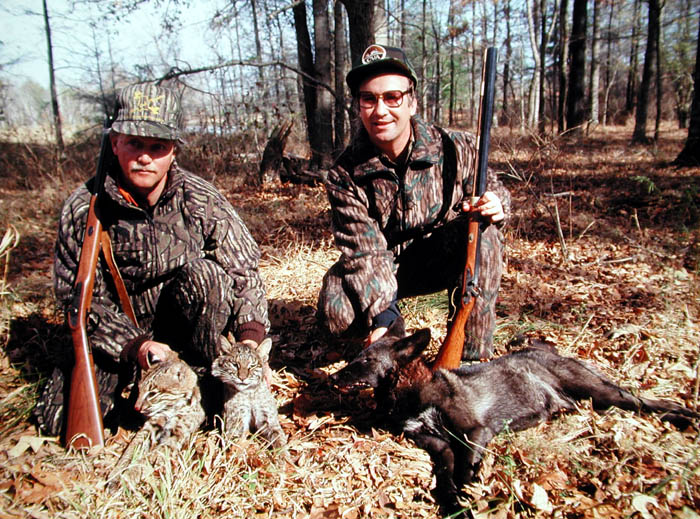 As
the populations of coyotes grow and prey on livestock and wild-game species,
the number of sportsmen, who hunt these critters also will continue to
increase. Although most people see coyotes as a nuisance, coyote hunters
say that as more people call and hunt coyotes and discover the challenge
of the sport, we may one day see the coyotes considered trophy animals
for hunters to take.
As
the populations of coyotes grow and prey on livestock and wild-game species,
the number of sportsmen, who hunt these critters also will continue to
increase. Although most people see coyotes as a nuisance, coyote hunters
say that as more people call and hunt coyotes and discover the challenge
of the sport, we may one day see the coyotes considered trophy animals
for hunters to take.
Check back each day this week for more about SMOKING EASTERN COYOTES ...
Day 1 - An Eastern Coyote
Hunt
Day 2 - The History Of Eastern Coyotes And
Their Rapid Increase
Day 3 - Where To Find Coyotes To Hunt
Day 4 - What Calls Work Best On Coyotes
Day 5 - How To Hunt Coyotes