
|
Features
|
|
|
|
Books
|
|
|
|
Fun & Games
|
|
|
|
Contact Us
|
|
|
John's Journal... Entry 241, Day 3
SPACE-AGE GOBBLERS WITH DON TAYLOR
Hunt Non-Pressured Gobblers And Create A Hunting Plan Using Your GPS
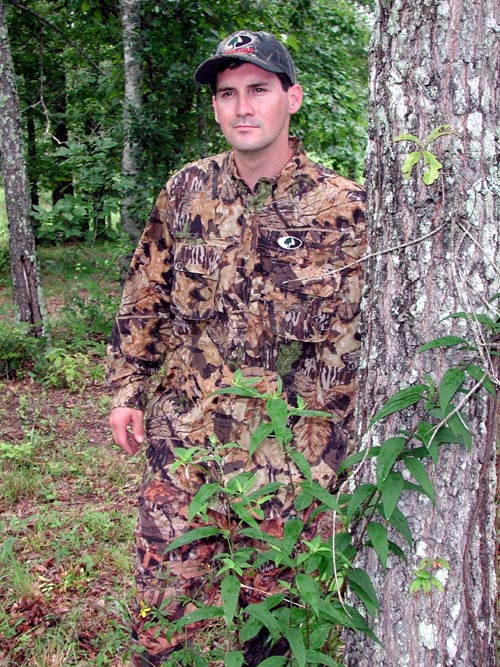 Editor's
Note: Global Positioning Systems (GPS) is a system of satellites that
circle the earth and give off signals. Each GPS satellite transmits its
precise location (position and elevation) and the start time of the transmission.
A GPS receiver acquires the signal and then measures the interval between
transmission and receipt of the signal to determine the distance between
the receiver and the satellite-a process called ranging. Once the receiver
has computed range for at least three satellites, the receiver's location
on the surface of the earth can be determined. Each satellite transmits
two types of data, almanac and ephemeris. Almanac data, general information
on the location and health of each satellite on the constellation, can
be collected from any satellite. A receiver with a current almanac in
its memory knows where in the sky to look for satellites, given its last
known position and the time of day. Ephemeris data is the precise satellite
positioning information that is used for ranging. Each satellite transmits
its own ephemeris data. Both almanac and ephemeris data are required for
a GPS receiver to locate and acquire satellites quickly and compute your
position. GPS produces accuracies of about 27 yards or better, bringing
you within visual range of a destination or a target. Most GPS receivers
allow you to log waypoints, either by number or name, which remain in
its memory until you either delete it or change it. Regardless of your
distance from a waypoint, the computer can calculate the direction you
need to travel and the distance from it. This week, Don Taylor, a longtime
turkey hunter from Alabama, shares the experiences he's had hunting with
his GPS receiver.
Editor's
Note: Global Positioning Systems (GPS) is a system of satellites that
circle the earth and give off signals. Each GPS satellite transmits its
precise location (position and elevation) and the start time of the transmission.
A GPS receiver acquires the signal and then measures the interval between
transmission and receipt of the signal to determine the distance between
the receiver and the satellite-a process called ranging. Once the receiver
has computed range for at least three satellites, the receiver's location
on the surface of the earth can be determined. Each satellite transmits
two types of data, almanac and ephemeris. Almanac data, general information
on the location and health of each satellite on the constellation, can
be collected from any satellite. A receiver with a current almanac in
its memory knows where in the sky to look for satellites, given its last
known position and the time of day. Ephemeris data is the precise satellite
positioning information that is used for ranging. Each satellite transmits
its own ephemeris data. Both almanac and ephemeris data are required for
a GPS receiver to locate and acquire satellites quickly and compute your
position. GPS produces accuracies of about 27 yards or better, bringing
you within visual range of a destination or a target. Most GPS receivers
allow you to log waypoints, either by number or name, which remain in
its memory until you either delete it or change it. Regardless of your
distance from a waypoint, the computer can calculate the direction you
need to travel and the distance from it. This week, Don Taylor, a longtime
turkey hunter from Alabama, shares the experiences he's had hunting with
his GPS receiver.
 A
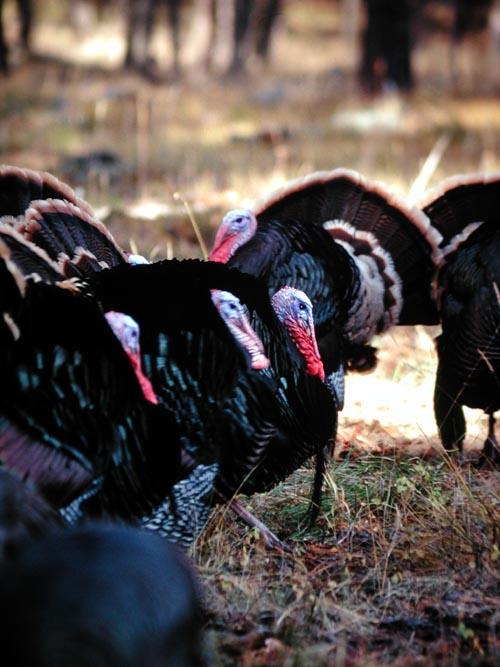
hand-held GPS receiver allows you to hunt areas other hunters won't or
can't hunt. Because most hunters rarely go more than 200 yards off any
road for fear of getting lost, the turkeys that roam close to any road
receive the most hunting pressure. By starting your hunt at least 1/4-mile
from a road, you can get into places and pinpoint gobblers most hunters
never hear or see. Often these non-pressured turkeys will respond to calling
better then birds called to constantly. Too, on public lands, the GPS
receiver enables you to hunt far more woods and pinpoint many more toms
than hunters who don't take advantage of the GPS technology.
A
hand-held GPS receiver allows you to hunt areas other hunters won't or
can't hunt. Because most hunters rarely go more than 200 yards off any
road for fear of getting lost, the turkeys that roam close to any road
receive the most hunting pressure. By starting your hunt at least 1/4-mile
from a road, you can get into places and pinpoint gobblers most hunters
never hear or see. Often these non-pressured turkeys will respond to calling
better then birds called to constantly. Too, on public lands, the GPS
receiver enables you to hunt far more woods and pinpoint many more toms
than hunters who don't take advantage of the GPS technology.
 GPS
Your Hunt Plan:
GPS
Your Hunt Plan:
Just like a good quarterback has several game plans, a turkey hunter needs
a game plan that will enable him to hunt a bird during the entire time
he has to hunt. Often a hunter only plans to go to a spot where he can
hear turkeys gobble from the roost and then try to call a bird to him.
But if that turkey doesn't come in, another hunter or a predator spooks
him, the tom gets with his hens, or any one of a hundred things happens
that prevents the bird from coming to the hunter, then the hunt's over.
However, by scouting, you can locate hunt sites that you can go to at
various times of the day and have a chance to call a gobbler. To maximize
your hunting time, use your GPS to move quickly and quietly from one location
to another by the shortest route.
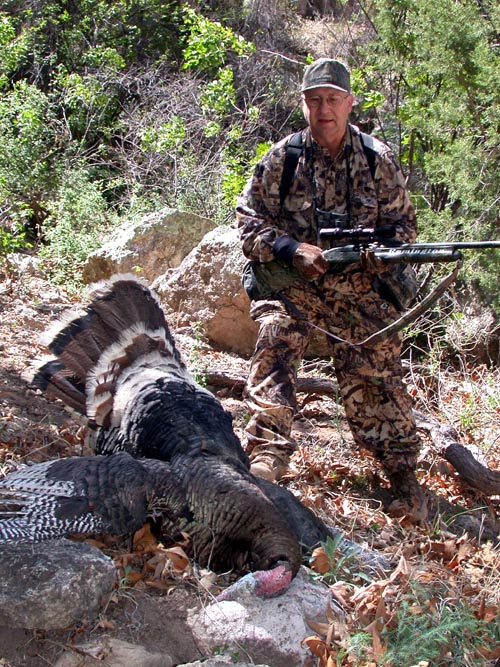 If
you've discovered an area that you want to hunt while scouting, save them
in your GPS receiver as waypoints. You also can mark a location where
turkeys like to move and breed before they fly up to their roosts. You
can hunt this plan all day with your GPS receiver, if you live in a state
that allows all-day turkey hunting. If you don't get your turkey in the
morning and you have to move several times to position yourself to call
him, instead of continuing to fight that bird, you may want to go to a
strut zone, feeding site or loafing area later in the morning where you
may meet that gobbler or another one. You can pull up the waypoint and
punch the "Navigate" button to go there.
If
you've discovered an area that you want to hunt while scouting, save them
in your GPS receiver as waypoints. You also can mark a location where
turkeys like to move and breed before they fly up to their roosts. You
can hunt this plan all day with your GPS receiver, if you live in a state
that allows all-day turkey hunting. If you don't get your turkey in the
morning and you have to move several times to position yourself to call
him, instead of continuing to fight that bird, you may want to go to a
strut zone, feeding site or loafing area later in the morning where you
may meet that gobbler or another one. You can pull up the waypoint and
punch the "Navigate" button to go there.
TOMORROW: THE SLUE-FOOT GOBBLER
Check back each day this week for more about SPACE-AGE GOBBLERS WITH DON TAYLOR ...
Day 1 - GPSing Albert
Day 2 - Be Lost No More
Day 3 - Hunt Non-Pressured Gobblers And Create
A Hunting Plan Using Your GPS
Day 4 - The Slue-Foot Gobbler
Day 5 - Give A Turkey To A Friend