
|
Features
|
|
|
|
Books
|
|
|
|
Fun & Games
|
|
|
|
Contact Us
|
|
|
John's Journal... Entry 241, Day 5
SPACE-AGE GOBBLERS WITH DON TAYLOR
Give A Turkey To A Friend
 Editor's
Note: Global Positioning Systems (GPS) is a system of satellites that
circle the earth and give off signals. Each GPS satellite transmits its
precise location (position and elevation) and the start time of the transmission.
A GPS receiver acquires the signal and then measures the interval between
transmission and receipt of the signal to determine the distance between
the receiver and the satellite-a process called ranging. Once the receiver
has computed range for at least three satellites, the receiver's location
on the surface of the earth can be determined. Each satellite transmits
two types of data, almanac and ephemeris. Almanac data, general information
on the location and health of each satellite on the constellation, can
be collected from any satellite.
Editor's
Note: Global Positioning Systems (GPS) is a system of satellites that
circle the earth and give off signals. Each GPS satellite transmits its
precise location (position and elevation) and the start time of the transmission.
A GPS receiver acquires the signal and then measures the interval between
transmission and receipt of the signal to determine the distance between
the receiver and the satellite-a process called ranging. Once the receiver
has computed range for at least three satellites, the receiver's location
on the surface of the earth can be determined. Each satellite transmits
two types of data, almanac and ephemeris. Almanac data, general information
on the location and health of each satellite on the constellation, can
be collected from any satellite.
 A
receiver with a current almanac in its memory knows where in the sky to
look for satellites, given its last known position and the time of day.
Ephemeris data is the precise satellite positioning information that is
used for ranging. Each satellite transmits its own ephemeris data. Both
almanac and ephemeris data are required for a GPS receiver to locate and
acquire satellites quickly and compute your position. GPS produces accuracies
of about 27 yards or better, bringing you within visual range of a destination
or a target. Most GPS receivers allow you to log waypoints, either by
number or name, which remain in its memory until you either delete it
or change it. Regardless of your distance from a waypoint, the computer
can calculate the direction you need to travel and the distance from it.
This week, Don Taylor, a longtime turkey hunter from Alabama, shares the
experiences he's had hunting with his GPS receiver.
A
receiver with a current almanac in its memory knows where in the sky to
look for satellites, given its last known position and the time of day.
Ephemeris data is the precise satellite positioning information that is
used for ranging. Each satellite transmits its own ephemeris data. Both
almanac and ephemeris data are required for a GPS receiver to locate and
acquire satellites quickly and compute your position. GPS produces accuracies
of about 27 yards or better, bringing you within visual range of a destination
or a target. Most GPS receivers allow you to log waypoints, either by
number or name, which remain in its memory until you either delete it
or change it. Regardless of your distance from a waypoint, the computer
can calculate the direction you need to travel and the distance from it.
This week, Don Taylor, a longtime turkey hunter from Alabama, shares the
experiences he's had hunting with his GPS receiver.
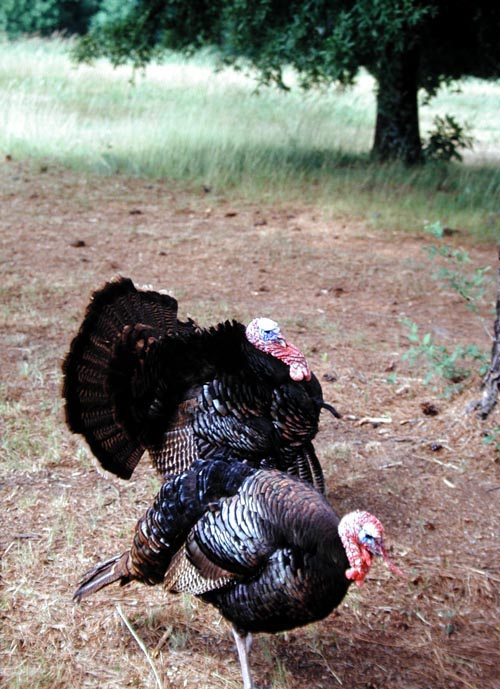 Sometimes
a turkey hunter may want to give away a gobbler. He may have located a
turkey and wants a friend to hunt it. Tell your friend the GPS coordinates
for getting to that gobbler. Then your friend can log those coordinates
into the memory of his receiver and "Navigate" to the spot where he can
begin to call and hunt the tom. However, usually people give away turkeys
because they can't take those turkeys themselves. I've often had tough-to-take
toms I've wanted other hunters to bag to keep me from having to fight
them every morning of turkey season and dream about them each night. Give
this kind of gobbler to someone else to solve your problem. A GPS receiver
will help you put your friend or enemy in a position to find and hunt
this bad gobbler. I love to hunt all kinds of wild turkeys, particularly
gobblers no one else has hunted. I like going deep into the woods where
other hunters won't and hunting new land and turkeys in other states where
I've never been before. But I don't enjoy getting lost.
Sometimes
a turkey hunter may want to give away a gobbler. He may have located a
turkey and wants a friend to hunt it. Tell your friend the GPS coordinates
for getting to that gobbler. Then your friend can log those coordinates
into the memory of his receiver and "Navigate" to the spot where he can
begin to call and hunt the tom. However, usually people give away turkeys
because they can't take those turkeys themselves. I've often had tough-to-take
toms I've wanted other hunters to bag to keep me from having to fight
them every morning of turkey season and dream about them each night. Give
this kind of gobbler to someone else to solve your problem. A GPS receiver
will help you put your friend or enemy in a position to find and hunt
this bad gobbler. I love to hunt all kinds of wild turkeys, particularly
gobblers no one else has hunted. I like going deep into the woods where
other hunters won't and hunting new land and turkeys in other states where
I've never been before. But I don't enjoy getting lost.
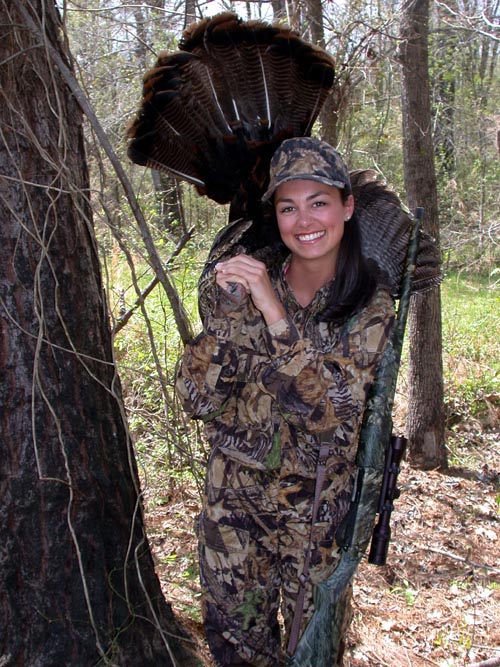 The
hand-held GPS receiver enables me to ...
The
hand-held GPS receiver enables me to ...
* hunt further and deeper in wilderness areas day and night,
* hunt new land in different states and
* keep up with gobblers on the land I hunt often. To increase your chances
of bagging more gobblers every year, plan to enlist satellites to help
you hunt turkeys. And don't forget, you won't have to come home to a cold
supper after being lost until after dark, if you'll use a GPS receiver.
Check back each day this week for more about SPACE-AGE GOBBLERS WITH DON TAYLOR ...
Day 1 - GPSing Albert
Day 2 - Be Lost No More
Day 3 - Hunt Non-Pressured Gobblers And Create
A Hunting Plan Using Your GPS
Day 4 - The Slue-Foot Gobbler
Day 5 - Give A Turkey To A Friend