
|
Features
|
|
|
|
Books
|
|
|
|
Fun & Games
|
|
|
|
Contact Us
|
|
|
John's Journal... Entry 71, Day 2
Calling Bucks
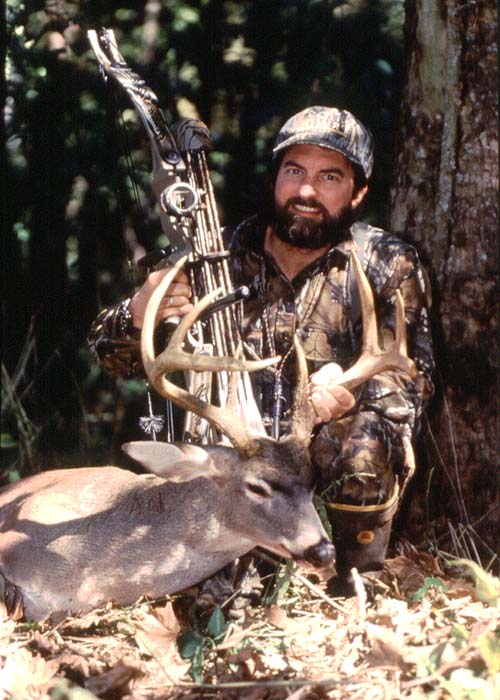 EDITOR'S
NOTE: Will Primos, the founder and president of Primos Hunting Calls,
lives in Jackson, Mississippi. His company, which celebrates its 25th
anniversary in 2001, has produced "The Truth Video Series" since 1986.
EDITOR'S
NOTE: Will Primos, the founder and president of Primos Hunting Calls,
lives in Jackson, Mississippi. His company, which celebrates its 25th
anniversary in 2001, has produced "The Truth Video Series" since 1986.
Question: How do you call bucks?
Answer: The big issue lies in the time of year you plan to call
to them. During the early season -- bow season -- the buck's horns may
be hard. The blood has quit flowing to the horns, and the deer have rubbed
off the entire velvet and are ready to breed at any time after that. The
shorter length of light in the day really gets the deer's hormones going
and puts them into the rut. The light and the buck's hormones activates
the buck's pituitary glands to put him in gear, which makes does receptive.
As you travel from October through November, December and January, the
occurrence of the rut depends on what part of the country in which you
hunt. If you hunt in the Midwest, the rut primarily occurs in the middle
of November, give or take a week, depending on your location. The way
you call to bucks and what the actual call means to the buck depends on
the time of year. A call will mean one thing on October 1, and on November
18 it'll mean something totally different. You have to understand the
deer's language and understand when to call, when not to call and when
not to call too much.
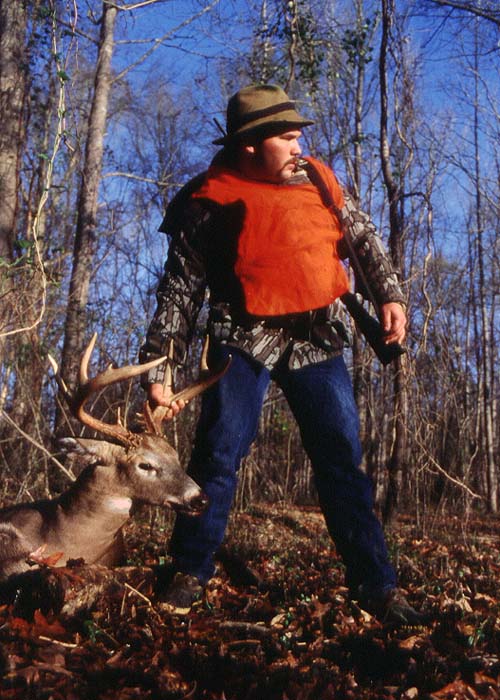 What
happens when you call to a deer is very involved, and I can't cover it
all here. But basically when you grunt at a deer, you tell him you're
a deer. If you grunt during the rut and you repeat the grunt several times,
you tell a buck you're actively pursuing a possible doe. A lot of people
don't realize that when a buck chases a doe, he crunches leaves, breaks
sticks and makes a lot of other noise. So, bucks become suspicious when
they travel by your stand at, say, 60 yards out, and you go to grunting
a bunch, and they don't hear anything else. You make them curious. However,
they won't close that distance and come to you because they think, "Where's
the buck? I can't hear him. I can't see him. Are we going to get in a
fight? Why should I go over there?" You've got to convince them. For this
reason, terrain features within 10 yards of your stand such as a ditch,
a cliff, a drop-off, a fallen tree or a cane thicket become so important.
Since a buck can't see well, and if you can't make any sounds in the leaves
or whatever, you've just got to hope he gets curious enough to come to
you.
What
happens when you call to a deer is very involved, and I can't cover it
all here. But basically when you grunt at a deer, you tell him you're
a deer. If you grunt during the rut and you repeat the grunt several times,
you tell a buck you're actively pursuing a possible doe. A lot of people
don't realize that when a buck chases a doe, he crunches leaves, breaks
sticks and makes a lot of other noise. So, bucks become suspicious when
they travel by your stand at, say, 60 yards out, and you go to grunting
a bunch, and they don't hear anything else. You make them curious. However,
they won't close that distance and come to you because they think, "Where's
the buck? I can't hear him. I can't see him. Are we going to get in a
fight? Why should I go over there?" You've got to convince them. For this
reason, terrain features within 10 yards of your stand such as a ditch,
a cliff, a drop-off, a fallen tree or a cane thicket become so important.
Since a buck can't see well, and if you can't make any sounds in the leaves
or whatever, you've just got to hope he gets curious enough to come to
you.
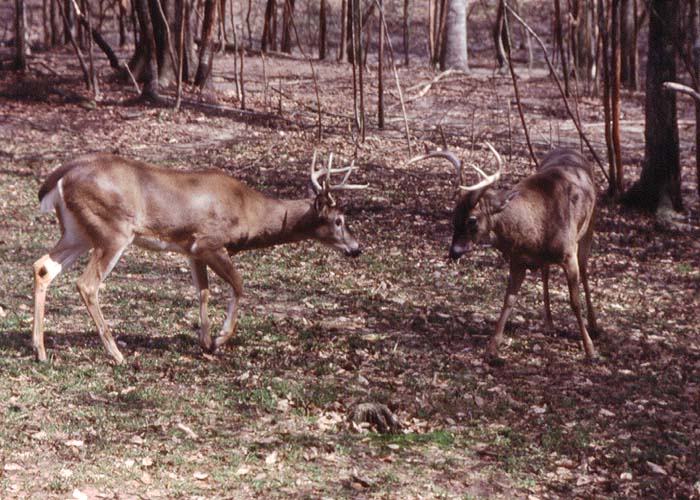 We've
cured a lot of that problem with the estrous bleat, which is real hard
to make with a mouth-blown call. You can best make this sound with what
I call a can call. It looks like a little can just like you may have had
as a child when you received a toy barn set that had a thing that sounded
like a cow. You turn the can over and back up and it goes "moo." That's
the same thing Primos Game Calls uses to make the estrous bleat of the
doe. We make two of these type of calls, the Easy Estrus Bleat and the
Hyper Estrus Bleat. They're very similar. They're both can calls that
you turn upside down and back up. They have phenomenal accuracy with sound.
I've killed two deer with the estrous bleat call this year. A buck knows
what this estrous bleat call sound means: a doe wants to breed, she's
just been bred, or she wants the company of a buck. She'll just stand
there to make those sounds. So when a buck hears that, he doesn't expect
to hear a lot of other sounds like deer chasing each other and that kind
of thing.
We've
cured a lot of that problem with the estrous bleat, which is real hard
to make with a mouth-blown call. You can best make this sound with what
I call a can call. It looks like a little can just like you may have had
as a child when you received a toy barn set that had a thing that sounded
like a cow. You turn the can over and back up and it goes "moo." That's
the same thing Primos Game Calls uses to make the estrous bleat of the
doe. We make two of these type of calls, the Easy Estrus Bleat and the
Hyper Estrus Bleat. They're very similar. They're both can calls that
you turn upside down and back up. They have phenomenal accuracy with sound.
I've killed two deer with the estrous bleat call this year. A buck knows
what this estrous bleat call sound means: a doe wants to breed, she's
just been bred, or she wants the company of a buck. She'll just stand
there to make those sounds. So when a buck hears that, he doesn't expect
to hear a lot of other sounds like deer chasing each other and that kind
of thing.
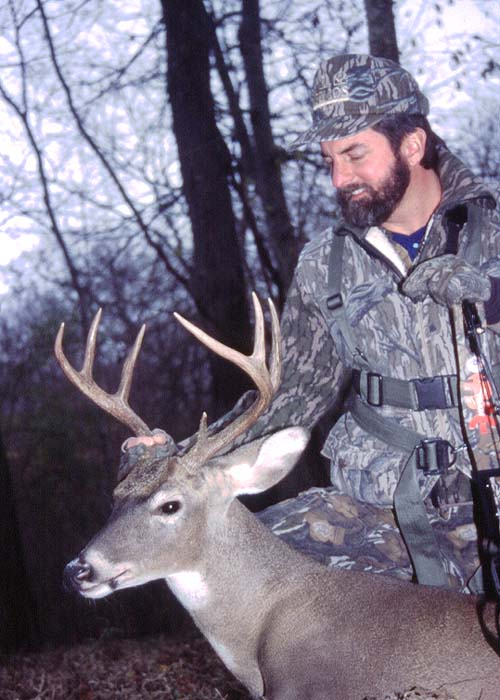 One
buck I grunted to last year would look but wouldn't come. I'd grunt very
softly and not a whole lot because I didn't want to make my sounds resemble
a buck that's just stood there -- grunting at another buck. I had a creek
behind me so I had a terrain feature that kept him from seeing everything.
He stopped and looked, but he wouldn't come. When I did the estrous bleat,
he turned and came immediately because he knew a hot doe had to be standing
there. That's the most effective calling I can tell you about.
One
buck I grunted to last year would look but wouldn't come. I'd grunt very
softly and not a whole lot because I didn't want to make my sounds resemble
a buck that's just stood there -- grunting at another buck. I had a creek
behind me so I had a terrain feature that kept him from seeing everything.
He stopped and looked, but he wouldn't come. When I did the estrous bleat,
he turned and came immediately because he knew a hot doe had to be standing
there. That's the most effective calling I can tell you about.
Tomorrow: Knowing When to Shoot
Check back each day this week for more about Will Primos--How To Get Close To Bucks ...
Day 1 -Tree Stand Placement
Day 2 -Calling Bucks
Day 3 -Knowing When to Shoot
Day 4 -What to Do When You Spook a Deer
Day 5 -Ten Secrets of Hunting Close