
|
Features
|
|
|
|
Books
|
|
|
|
Fun & Games
|
|
|
|
Contact Us
|
|
|
John's Journal... Entry 65, Day 2
Trash Trails and Meandering Trails
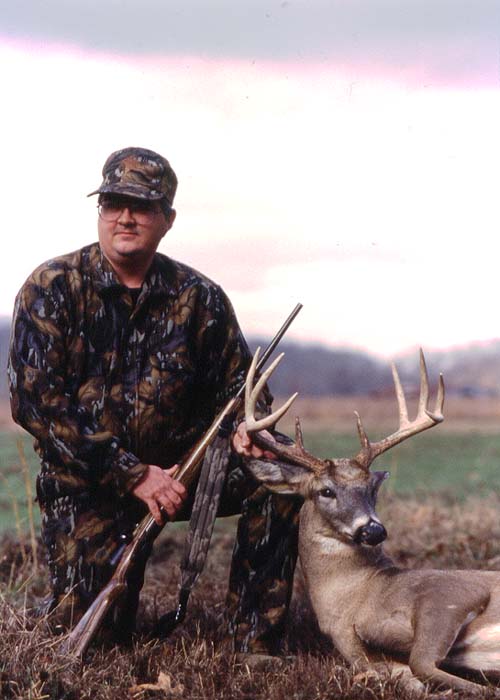 EDITOR'S
NOTE: Simply finding a deer trail won't provide enough information
to make you hang a tree stand and plan to hunt that trail. Many ingredients
make some deer trails better than others. To effectively hunt trails,
you need to know ..
EDITOR'S
NOTE: Simply finding a deer trail won't provide enough information
to make you hang a tree stand and plan to hunt that trail. Many ingredients
make some deer trails better than others. To effectively hunt trails,
you need to know ..
* why and when the deer use the trail,
* where the deer will go and
* what time of day or night the deer will move down the trail.
With this information, you can hunt trails and take deer more productively than a hunter who simply finds a trail and hangs a tree stand. Let's take a closer look at some different types of deer trails and what you can learn from these trails to help you hunt more effectively.
Besides historical ones (see Day 1), Larry Norton of Pennington, Alabama, finds and hunts other invisible trails -- trash trails -- in pine plantations. Usually with clear-cut property, the stumps, limbs and logs get left piled-up in a long windrow and burned. Windrows still remain after the landowner plants the area in pines. As the young pines grow taller than the windrows, you can no longer spot these old trash piles.
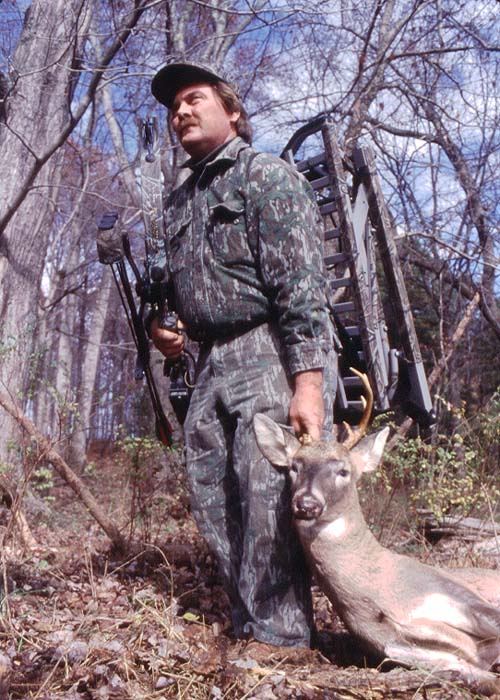 "The
trash piles create a natural barrier on what would otherwise be flat ground,"
Norton explained. "These trails are primarily travel and feeding trails
and usually have very fertile earth that produces high-quality deer food
like honeysuckle, blackberry bushes and greenbrier. The deer can feed
on the trash piles and stay in thick cover during daylight hours. Most
often you'll have to hunt these trash piles from ground blinds because
a young pine can't hold a tree stand. The understory may only be clear
for 5 to 6 feet above the ground."
"The
trash piles create a natural barrier on what would otherwise be flat ground,"
Norton explained. "These trails are primarily travel and feeding trails
and usually have very fertile earth that produces high-quality deer food
like honeysuckle, blackberry bushes and greenbrier. The deer can feed
on the trash piles and stay in thick cover during daylight hours. Most
often you'll have to hunt these trash piles from ground blinds because
a young pine can't hold a tree stand. The understory may only be clear
for 5 to 6 feet above the ground."
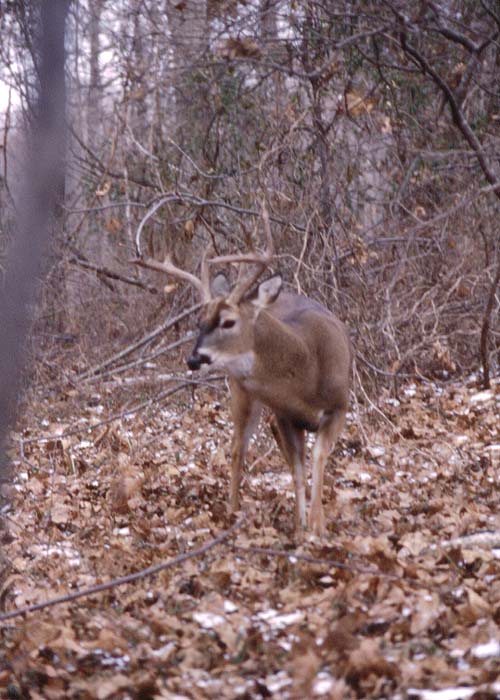
Sometimes deer take routes through the woods without leaving trails. Even when deer frequent a particular area, they may not walk down a certain path as they move through this region but instead will meander through the woods. Often meandering trails occur where two types of habitat pinch down a woodlot and create a funnel. Most of the time, deer will meander through that funnel rather than taking a specific route. Falling leaves will keep you from seeing little if any sign on the ground.
 Wildlife
biologists and longtime deer hunters have found that hunting a funnel
that narrows down to one specific area improves the odds of the deer coming
by you, instead of their walking past you out of range. For example, a
dead tree that's down in a funnel area that the deer must walk around
is a good place to set up your stand. Any break in the funnel where deer
must pause to go under a fence or to cross a stream also will be productive
spots for taking deer, because the deer must stop and think about how
to traverse the obstacle rather than looking for danger. Too, they're
not spending as much time looking up in the trees if they're negotiating
obstacles in the funnel.
Wildlife
biologists and longtime deer hunters have found that hunting a funnel
that narrows down to one specific area improves the odds of the deer coming
by you, instead of their walking past you out of range. For example, a
dead tree that's down in a funnel area that the deer must walk around
is a good place to set up your stand. Any break in the funnel where deer
must pause to go under a fence or to cross a stream also will be productive
spots for taking deer, because the deer must stop and think about how
to traverse the obstacle rather than looking for danger. Too, they're
not spending as much time looking up in the trees if they're negotiating
obstacles in the funnel.
Tomorrow: Terrain Trails and Mating trails
Check back each day this week for more about Reading Whitetails' Travel Routes ...
Day 1 -Types of Whitetail
Highways
Day 2 -Trash Trails and Meandering Trails
Day 3 -Terrain Trails and Mating Trails
Day 4 -Water, Food and Bedding Trails
Day 5 -Escape Trails and Night Trails