
|
Features
|
|
|
|
Books
|
|
|
|
Fun & Games
|
|
|
|
Contact Us
|
|
|
John's Journal... Entry 130, Day 1
THE SUPER GENE
Do Monster Bucks Produce Monster Bucks?
 EDITOR'S
NOTE: What role does genes play in your local deer herd? Can the introduction
of a monster buck into a herd assure quality deer for years to come? The
answer to these and other questions will definitely surprise you. If a
Boone and Crockett buck was introduced into your deer herd, would he produce
super bucks? Could you buy a monstrous-sized Alberta buck and bring it
to Tennessee, Virginia, Arkansas or Alabama and expect the buck to breed
with does and produce offspring with heavier body weights and larger antlers?
Through selective breeding, could you implant does with embryos that carry
super genes to produce offspring that become bigger bucks with wider racks?
To get the answer to these questions and many more about genes and their
potential, I talked with Dr. Harry Jacobson from the Department of Wildlife
and Fisheries at Mississippi State University in Starkville, Mississippi.
One of the nation's leading deer researchers, Jacobson currently studies
genetic effects on deer populations.
EDITOR'S
NOTE: What role does genes play in your local deer herd? Can the introduction
of a monster buck into a herd assure quality deer for years to come? The
answer to these and other questions will definitely surprise you. If a
Boone and Crockett buck was introduced into your deer herd, would he produce
super bucks? Could you buy a monstrous-sized Alberta buck and bring it
to Tennessee, Virginia, Arkansas or Alabama and expect the buck to breed
with does and produce offspring with heavier body weights and larger antlers?
Through selective breeding, could you implant does with embryos that carry
super genes to produce offspring that become bigger bucks with wider racks?
To get the answer to these questions and many more about genes and their
potential, I talked with Dr. Harry Jacobson from the Department of Wildlife
and Fisheries at Mississippi State University in Starkville, Mississippi.
One of the nation's leading deer researchers, Jacobson currently studies
genetic effects on deer populations.
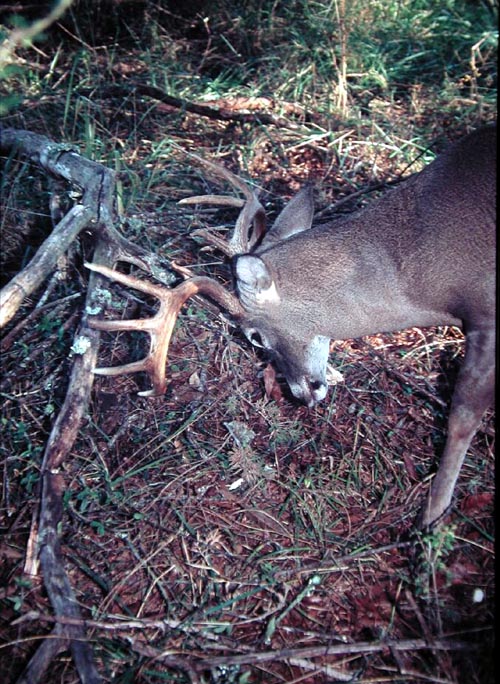 Question:
Can scientists produce big antlers through genetic selection?
Question:
Can scientists produce big antlers through genetic selection?
Answer: A hunter can do little genetically to improve antler development
and body weights in bucks within a wild deer population. However, in pen
studies, biologists have selectively improved antler quality. With specific
selection for certain traits, we've produced deer with specific characteristics,
such as additional antler points and heavier antler mass. We haven't tried
to produce super bucks, but we have studied the relationship in terms
of predictability and inheritance estimates relative to antler traits.
My job is to study the role genetics play in a wide range of deer traits.
Question: What role does genetics play in determining
a whitetail's body weight and skeletal size?
Answer: Scientists find differences across the sub-species of deer. For
example, in the most northern part of the whitetail's range, the deer
have larger body weights and skeletal size than Texas deer.
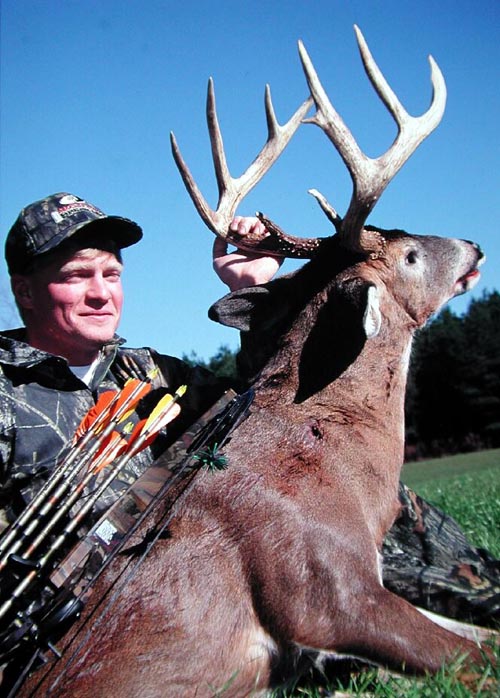 Question:
What would happen if a Wisconsin buck bred with a Texas doe and the offspring
lived in Texas? Would you have bigger offspring than the average-size
Texas deer?
Question:
What would happen if a Wisconsin buck bred with a Texas doe and the offspring
lived in Texas? Would you have bigger offspring than the average-size
Texas deer?
Answer: Not necessarily. In all likelihood, the Wisconsin buck's body
size will be larger than a Texas buck's, but the offspring may grow to
the same size as the average Texas deer.
Question: Since northern deer usually have bigger antlers
than southern deer, if you cross a buck from Alberta, Canada, with a buck
from Georgia or Mississippi, will the offspring have larger than average
antlers?
Answer: You can't say that northern bucks always have larger antlers than
southern bucks. The bucks in south Texas develop much larger antlers than
similarly aged deer in other areas of the country. Body size and antler
development don't necessarily go hand in hand either. Although south Texas
deer may have relatively small body weights, they may be endowed with
extremely large antlers. Northern deer may have a large body size but
not big antlers.
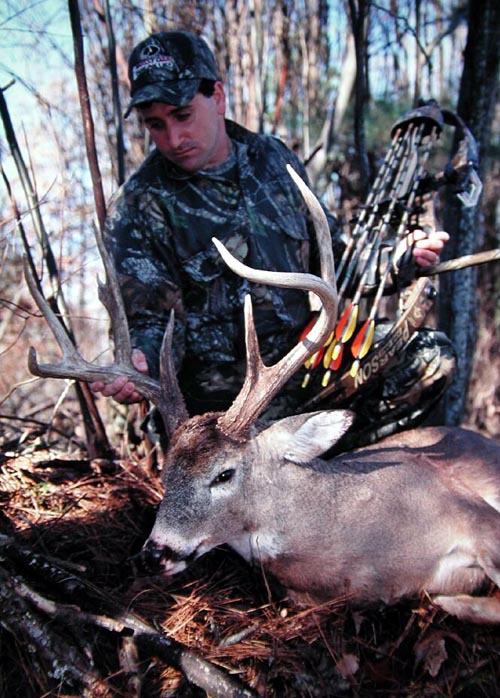 TOMORROW:
CAN BIOLOGISTS PRODUCE MONSTER BUCKS?
TOMORROW:
CAN BIOLOGISTS PRODUCE MONSTER BUCKS?
Check back each day this week for more about The Super Gene ...
Day 1 - Do Monster Bucks
Produce Monster Bucks?
Day 2 - Can Biologists Produce Monster Bucks?
Day 3 - What Is A Trophy Buck?
Day 4 - Don't Shoot Spikes
Day 5 - Managing A Deer Herd For Big Bucks