
|
Features
|
|
|
|
Books
|
|
|
|
Fun & Games
|
|
|
|
Contact Us
|
|
|
John's Journal... Entry 181, Day 5
THE WAR AGAINST NUTRIA
How Nutria Have Affected Inshore Fish Populations
 EDITOR'S
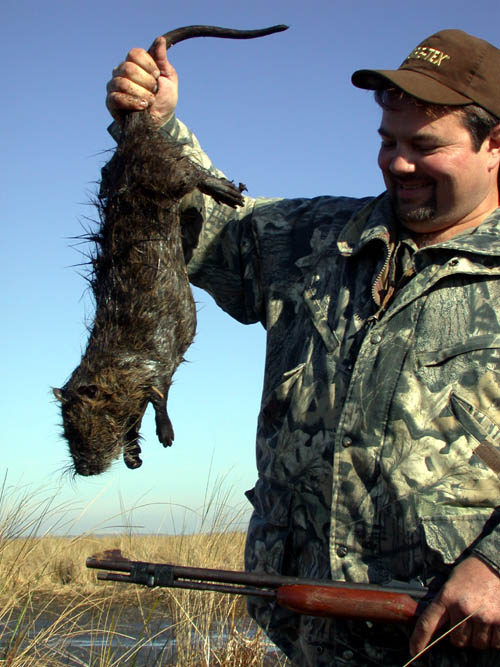
NOTE: Nutria, semi-aquatic rodents with the proper
name of coypu, have eaten away at Louisiana's marshlands for some years.
The federal government has sent Louisiana $2 million to fight the war
on nutria. These l2- to 18-pound demons detrimentally impact about 100,000
acres of wildlife-rich marshlands each year. If someone doesn't stop them,
other coastal states may face drastic land loss thanks to these furry
Argentine invaders. So, now predator hunters have a new predator to hunt.
And sportsmen who get permission to hunt nutria from Louisiana landowners
can get paid for the nutria tails they harvest.
EDITOR'S
NOTE: Nutria, semi-aquatic rodents with the proper
name of coypu, have eaten away at Louisiana's marshlands for some years.
The federal government has sent Louisiana $2 million to fight the war
on nutria. These l2- to 18-pound demons detrimentally impact about 100,000
acres of wildlife-rich marshlands each year. If someone doesn't stop them,
other coastal states may face drastic land loss thanks to these furry
Argentine invaders. So, now predator hunters have a new predator to hunt.
And sportsmen who get permission to hunt nutria from Louisiana landowners
can get paid for the nutria tails they harvest.
Unlike cattle and horses that eat the tops of the plants they graze on, nutria eat the roots. These furry critters that average 16- to 18-pounds. They swim along the canals and the waterways, devouring the roots that hold the marsh grass in the mud. Then the mud and the silt once held in place by the grass falls away and becomes sludge, detrimentally impacting the spawning habitat of inshore fish.
 "The
nutria alone don't create the problem," Jeff Marks, a biologist with Louisiana's
Wildlife and Fisheries, states, "but once they destroy the roots that
hold the soil, the marsh dirt washes away when the coastal region has
high water or storm events. The plants are what holds the marsh together;
without them we have no marsh.
"The
nutria alone don't create the problem," Jeff Marks, a biologist with Louisiana's
Wildlife and Fisheries, states, "but once they destroy the roots that
hold the soil, the marsh dirt washes away when the coastal region has
high water or storm events. The plants are what holds the marsh together;
without them we have no marsh.
"In the late 1940s, nutria began to appear in the Louisiana trappers' fur harvest," Marks comments. "By 1980, however, fur prices had declined considerably, and the wild nutria population increased."
In the late 80s and early 90s, Louisiana's Department of Wildlife and Fisheries noticed that the nutria's foraging habits were literally eating away the marsh. The state offered a 25-cent-per-nutria bounty to convince trappers to take them. However, although the state passed the legislation, it did not appropriate any money to pay the hunters and the trappers. Inevitably, the program failed. Next the state of Louisiana attempted to create a market for nutria meat, a program still in use today that had some success. However, the future of the marshes may lay with a new program funded by the federal government that has approved $1.6 million per year over the next five years to pay trappers and hunters to take nutria.
 Even
with the war in full force, nutria have proved their shrewdness and adaptability.
Females begin breeding when they're only 3-months old and produce on the
average 1-1/2 litters per year, with each litter consisting of an average
of five offspring. In addition, young nutria only nurse for a short time,
which means they quickly start eating the marsh vegetation, including
reeds, rushes, cattails, arrowhead and sawgrass. Newly-born nutria have
their eyes open at birth, and biologists have observed them moving about
and eating vegetation within a few hours. A nutria eats approximately
2.5 to 3.5 pounds of food per day, including shellfish.
Even
with the war in full force, nutria have proved their shrewdness and adaptability.
Females begin breeding when they're only 3-months old and produce on the
average 1-1/2 litters per year, with each litter consisting of an average
of five offspring. In addition, young nutria only nurse for a short time,
which means they quickly start eating the marsh vegetation, including
reeds, rushes, cattails, arrowhead and sawgrass. Newly-born nutria have
their eyes open at birth, and biologists have observed them moving about
and eating vegetation within a few hours. A nutria eats approximately
2.5 to 3.5 pounds of food per day, including shellfish.
For information on the World Championship Nutria Hunt or to go nutria hunting, call the Lodge of Louisiana at (504) 689-0000, or visit the Web site at www.lodgeoflouisiana.com.
Check back each day this week for more about THE WAR AGAINST NUTRIA ...
Day 1 - A Call to War Against
Nutria
Day 2 - The History of Nutria
Day 3 - Nutria Hunting for Money
Day 4 - Nutria Festivities
Day 5 - How Nutria Have Affected Inshore
Fish Populations